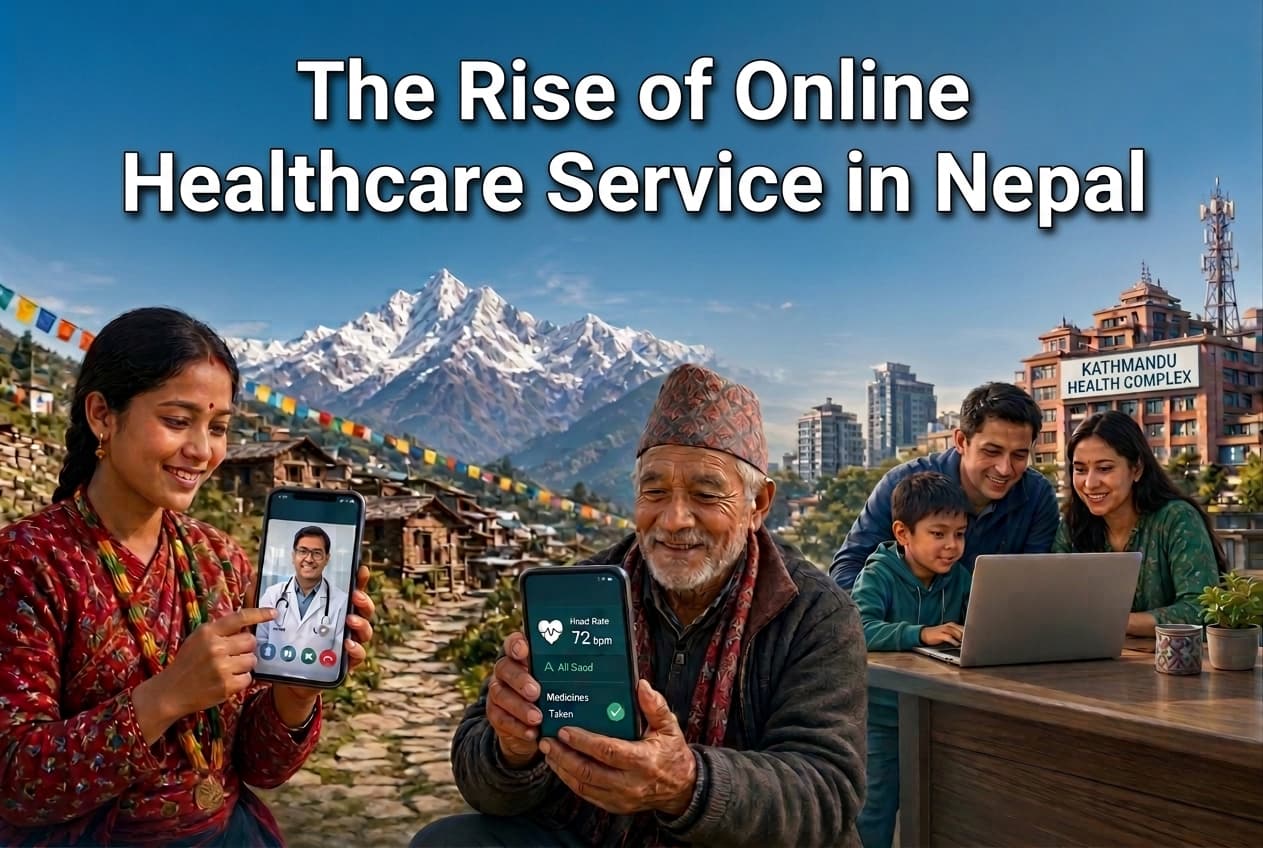
Healthcare is an integral part of people’s everyday lives. It is a necessity when people get ill and require timely and proper treatment, consultation with medical workers, laboratory examinations, medicines, and other services. Online Healthcare Services in Nepal are making it easier for people to connect with doctors, book appointments, receive medical guidance, and access healthcare information without always visiting a hospital or clinic. Healthcare services in Nepal, as in many other developing countries, have been unapproachable for many people. Those who live in remote areas should often spend a lot of time searching for the best hospitals, clinics, and experienced doctors. Even people living in large cities can have difficulties with the long queue organization and spend hours waiting for their turn.
However, new technologies offer new opportunities, and smartphones, internet access, online platforms, and other modern innovations allow people to get most of the services at home. Online healthcare marketplaces are a great way to get in touch with medical workers and receive the required services without going to hospitals and clinics.
It should be noted that online healthcare services are not a way to fully satisfy all medical needs since many procedures still require personal visits to the clinics. However, they are a convenient and affordable option for many routine procedures, consultations, scheduling, and other services.
Here we will discuss the online healthcare services emerging in Nepal, their advantages, disadvantages, and further prospects.
What Are Online Healthcare Services?
Online healthcare services are healthcare-related services that are delivered or supported by means of online technology and digital tools like smartphones, computers, websites, applications, video-conferencing, phone calls, and other digital means of communication.
Depending on the service provider, online healthcare can help an individual to
- consult a doctor online,
- book a medical appointment,
- video or audio conference with a healthcare professional,
- seek advice,
- share relevant medical reports with a doctor,
- search for healthcare-related information,
- get referred or guided on the next step of therapy,
- access selected digital information or records,
- communicate with a healthcare institution via digital means.
An important component of online healthcare is telemedicine, which refers to methods for providing healthcare through the means of communication. Telemedicine can help connect patients or medical staff with doctors and specialists through digital technology, where doctors and experts might be present elsewhere.
Telemedicine is a system where medical doctors and professionals offer their expertise to people or institutions through long-distance communication. In Nepal, telemedicine has been used to bring healthcare services to people and healthcare professionals in far-off places. The Ministry of Health and Population's digital health programmed reports that there is a centralized telemedicine model where healthcare professionals can offer their expertise to the front-end healthcare workers through technology.
Thus, online healthcare should not be considered a substitute for hospitals but rather complement existing healthcare systems while making some services more accessible.
Why Is Online Healthcare Growing in Nepal?
Several factors are driving the potential growth of online healthcare in Nepal. Increasing levels of Internet use, the ubiquity of smartphones, shifting consumer expectations, and the need to provide services to persons outside major centers are all contributing factors.
Growing Internet and Cellular Use
Healthcare services offered through online platforms or via smartphone "apps" can only grow if there is general availability of devices and access to the Internet. Nepal has seen dramatic growth in this arena.
According to Data Reportal's Digital 2026 report, Nepal had 16.6 million Internet users as of October 2025, representing approximately 56% penetration among the country's population. As of the same date, there were approximately 32.4 million cellular mobile connections in use in Nepal, according to the same source.
These figures do not represent complete penetration by any means; Nepal has a long way to go before achieving "connectivity ubiquity." However, overall growth in adoption will lead to a larger audience for digital services, including healthcare services.
The Need for Easier Access to Physicians
Nepal's geography makes healthcare challenging. Not all individuals have ready access to physicians and other healthcare professionals, especially in remote, mountainous areas.
An online consultation cannot address every healthcare need, but it can potentially replace a long-distance commute by necessitating only an in-person visit. One can have a video or voice consultation with a physician and address a nonurgent issue without having to make a long drive to the nearest hospital or clinic.
Changing Patient Expectations
Patients are accustomed to using their phones to communicate, pay, shop, and get virtually any service they can imagine. As a result, patients have come to expect that healthcare providers will deliver the same level of convenience and choice. They are demanding online appointment bookings, consultations remotely via video or phone, and the ability to communicate digitally with their providers.
Lessons From the COVID-19 Period
COVID-19 pandemic increased the need for virtual healthcare in Nepal as in most of the world. People prefer minimal contact as much as possible during the COVID-19 pandemic. However, they still require medical care, particularly in rural areas, where reaching the nearest medical facility is challenging.
The Ministry of Health and Population together with WHO opened a teleconsultation center at the Bir Hospital in December 2021. It began providing free services through a dedicated hotline manned by doctors and nurses. It was an initiative that sought to bridge the gap in hard-to-reach areas by giving patients easier access to medical professionals.
How Does Online Doctor Consultation Work?
The online healthcare platforms are also playing a growing role in helping patients find doctors, get information on available services and make appointments without having to go to the clinic first. Such changes are making it easier and more convenient for them to schedule a consultation. Discover how digital platform are changing doctor appointment and how technologies are facilitating patient access to health care providers.
An online doctor consultation in Nepal typically follows a straightforward procedure that may differ slightly depending on the platform or provider.
Step 1: Choose a Healthcare Professional
The patient selects a doctor or healthcare professional to whom they want to turn to, depending on the medical issue and the specialty that the doctor has.
For example, a person may need to consult a general physician for common symptoms or a specialist for a particular health concern.
Step 2: Book a Consultation
The patient can choose an available date and time via the healthcare platform or contact the provider according to its booking process.
Digital appointment systems can reduce the need to visit a facility simply to schedule an appointment.
Step 3: Sharing Relevant Information
Prior to or during consultation, the patient may be compelled to share information concerning symptoms, prior medical history, current drugs or relevant diagnostic reports.
Patients must provide accurate information since the doctor will be relying on the information given. The doctor heavily relies on information provided during a remote consultation.
Step 4: Speaking With the Doctor
The consultation may occur via video, audio, telephone or any other approved form of communication
The doctor may ask questions, talk about symptoms, go through reports and give advice.
Step 5: Following the Doctor's Advice
The doctor may ask the patient to monitor the symptoms, take medication, undertake tests, visit a clinic or hospital or consult another medical professional.
If the doctor feels that a manual examination is required, an online consultation should not be undertaken.
Benefits of Online Healthcare Services in Nepal
There are various advantages of online healthcare services development in Nepal for patients and medical professionals.
1. Convenience of Health Clinics
The primary benefit of online services in medical institutions is the convenience for patients.
With virtual consultation option, people can avoid going to hospitals or clinics for less serious conditions and communicate with doctors from the comfort of their homes.
Such services are beneficial for individuals who are tied to a location, those needing regular check-ups, and residents of remote areas who have to travel long distances to get to a medical facility.
2. Saves travel time
It can save a lot of time for people who have to go to other districts for checkups in the hospital.
With online consultation, you can use the time you would have spent traveling and waiting for an appointment to do something else.
3. Helps people in remote areas
Nepal has a diverse topography ranging from mountains to plains.
This means healthcare services are unevenly spread throughout the country. Telemedicine can help bridge this gap by connecting doctors and patients virtually. The telemedicine program envisioned by Nepal's e-Health strategy also aims to tap into the country's medical expertise by connecting its frontline workers with the appropriate medical professionals.
4. Easier Follow-Up Care
It can be easier to help someone with follow-up care after an initial medical exam or procedure.
For instance, one of these services could allow a doctor to talk with a patient after an in-person appointment if they need to discuss a report or ask them if their symptoms are getting better and an examination isn't needed.
5. Access to Specialists
It might not be possible to see a specialist doctor in some areas.
Through some of these services, it may be possible to let local doctors or patients contact a specialist in another city or a hospital that has more resources.
This can still leave the need for an actual specialist if one is required, but it can help them with things like instructions or referrals.
6. Reduction of unnecessary travel
If a doctor determines that a patient’s concern can be managed with advice or requires a different category of healthcare provision, the patient will be saved the trouble of an unnecessary journey.
This promotes efficiency and saves transportation costs.
7. Maintenance of continuity of care
Electronic records and related systems can be used to maintain continuity of care when implemented properly.
WHO Nepal reported in 2025 that an electronic medical record system was transferred to the G.P. Koirala National Center for Respiratory Diseases in Gandaki Province. It was designed to reduce dependence on paper records and promote timely access to medical information and decision-making. Similarly, WHO reported that an electronic medical record system at Karnali Academy of Health Sciences would be able to support follow-up consultations.
8. Greater Convenience for Follow-Up and Communication
The use of digital communication can enable patients to contact healthcare providers more easily according to the service's available communication channels.
This can be beneficial if patients have questions after a consultation or if they need clarification about the next step in their care.
Online Healthcare Services and Rural Nepal
One of the most important areas for digital healthcare in Nepal is rural and remote healthcare access.
People in major cities tend to have more healthcare facilities and specialists available nearby. In remote areas, the situation can be fundamentally different. Long and challenging travel distances, poor roads, limited transportation, and fewer specialized service options are potential barriers to obtaining care.
Telemedicine can help partially alleviate these problems by bridging healthcare professionals and patients with experts in other locations.
Enabling Local Healthcare Workers
Digital healthcare is not only about directly linking patients with physicians. Telemedicine systems and solutions can also link healthcare workers with specialists.
For example, a health worker in a remote area may be in need of professional advice regarding a particular situation. The telemedicine system may potentially provide the opportunity for the health worker to consult a physician or specialist in another location. Nepal’s centralized telemedicine model is built around this very concept, whereby healthcare professionals at the central hospital can advise less experienced community health workers in various parts of the country.
Reducing Geographic Barriers
Digital healthcare cannot entirely eliminate the geographic barriers that Nepal currently faces. But telemedicine can reduce the relevance of them for particular communication and consultation needs.
That is especially valuable for situations wherein the expertise of a specialist is required but a physical examination is not needed.
What Services Can Be Provided Online?
The services offered online depend on the healthcare provider, technology, medical specialty, and the patient’s condition. Some of the services that various online portals offer are:
General Medical Consultation
Patients can consult online with a doctor about common health concerns and get advice on the best course of action.
Follow-Up Consultation
A patient can have a follow-up consultation with his doctor online after initial treatment.
Specialist Consultation
Some portals offer a service that helps patients connect with specialists about their health concerns.
Appointment Booking
The appointment booking service allows patients to make appointments online without visiting the healthcare facility.
Health Information
Through health information services, patients can access information on disease prevention, lifestyles, symptoms of illnesses, and other health information.
Referral Guidance
Referral guidance is where a healthcare professional advises a patient to seek care from a specific healthcare professional or facility after an examination.
What Online Healthcare Cannot Replace
Although the healthcare sector in Nepal is being digitized, there are still some limitations to modern technology. The current level of online consultation cannot replace all medical services available.
Physical Examination
Sometimes, a medical professional is required to look at the patient physically to examine specific areas of the body, check specific signs, or do any treatment.
Emergency Care
In emergency cases, physical health examination is prioritized, and an online consultation cannot be substituted for emergency care.
Surgery and Procedures
Surgical procedures, injection, treatment of wounds and injuries, imaging, laboratory tests, and many other services need to be done physically by trained professionals and with appropriate equipment.
Diagnostic Testing
Testing and diagnostic services like lab tests or imaging may be needed even when a doctor is consulted online.
As seen, online healthcare services are only an addition to the regular health services; they cannot provide every healthcare service available in hospitals and clinics.
Challenges of Online Healthcare in Nepal
Despite the many advantages of online healthcare, there are also several disadvantages.
1. Internet Accessibility
The number one concern for online healthcare is undoubtedly the internet connection.
Although the internet is extremely useful, there are still some people who do not have easy access to it.
According to “Nepal’s Internet and Mobile Penetration Hits New High, as of 2026,” which was published by DataReportal on April 3, 2023, only 56% of Nepal’s population was using the internet as of the end of 2025, leaving roughly 44% of Nepalese citizens without internet access.
This is a major issue considering the fact that internet accessibility is essential to the success of online healthcare.
2. Literacy
Some patients might not be very familiar with accessing information on the internet.
Having intuitive online healthcare websites and apps would go a long way in helping these patients.
3. Privacy
The privacy and security of patients’ health and personal information should always be a top priority.
Although many online healthcare services take measures to ensure patients’ information is secure, patients themselves must also be mindful of what information they share online and with whom they share it with, especially if it is not an official source.
4. Physical Examination Limitations
Doctors are only human, too.
There are certain physical examinations that cannot be done virtually, so there is a chance that there may come a point where the patient will have to go to the doctor’s office anyway, despite the initial examination being done virtually.
5. Technical Difficulties
There is always a chance that the connection might be lost due to a poor internet connection, problems on either end of the video call, problems with the device being used for the video call, and many other issues.
6. Trust and Accreditation
Patients should always be confident and assured that they are receiving quality care and that they are consulting with qualified and competent professionals.
The online healthcare website should make sure the patients are informed about the professionals and services they offer and make sure they comply with all regulations and qualifications.
The Role of Digital Health in Nepal's Healthcare System
Digital healthcare is set to become an increasingly significant element of the modern healthcare system.
Nepal’s previous eHealth strategy aimed to promote telemedicine as a mean to increase access to general and specialist treatment, develop telehealth centres, ensure connectivity, and foster workforce development and digital health technologies.
Since then, Nepal has made considerable progress in electronic medical records, telemedicine, health information systems, and overall digital health planning.
In particular, in June 2024, with the support of the World Health Organization, the Ministry of Health and Population held a consultation on Electronic Health Records and Telemedicine. The meeting’s objective was to establish a standardized operating procedure for integrated EHR and telemedicine in Nepal. Thus, in addition to specific tools, such as websites and smartphone apps, digital healthcare is indeed set to become a key component of the overall health system development in the country.
How Patients Can Use Online Healthcare Responsibly
Patients should use online health care wisely and cautiously.
Select Qualified Healthcare Professionals
Before making an appointment for consultation through online platforms, patients should ensure the credentials of the healthcare professional to confirm if the person is authorized and qualified to offer the intended service.
Provide Accurate Information
It is essential for patients to give accurate information regarding their symptoms, drugs, allergies, conditions, and relevant medical reports. In case of giving incomplete information, it may complicate the diagnosis.
Keep Reports Ready
If a patient has earlier laboratory reports, prescriptions, scan results, or any other relevant medical records, it is advisable to set them aside for easy access.
Follow Doctor’s Advice
Even though seeking health information online can be useful, such information should not replace the guidance and prescriptions of a qualified healthcare professional. If the doctor asks for an in-person examination or test, it is essential to follow their advice.
Avoid Sharing Sensitive Information
It is crucial to avoid giving personal and sensitive information to unfaithful sites and individuals. Patients should only use trusted portals that offer information regarding their privacy and services.
The Future of Online Healthcare Services in Nepal
The future of online healthcare services in Nepal is intrinsically linked to the country’s overall digitization.
As the internet, smartphones, electronic health records, digital payments, and other technologies develop, more healthcare services and functions will inevitably go digital.
More Integration of Digital Health Information
Healthcare IT systems in the future will likely be more integrated, thus enabling the exchange of relevant digital information between different EHRs, laboratory information, appointment scheduling, referrals, and other pertinent medical data when the relevant standards have been established.
Better Telemedicine Network
Telemedicine networks can be expanded to better connect urban medical facilities with their rural and remote counterparts. This would enable the former to provide better support to the latter, including consultation services that would not require patients or doctors to travel great distances to seek or provide services.
More Emphasis on Patient Centered Digital Services
More emphasis will be placed on providing patient-centered services through online portals, which will likely include appointment scheduling, consultation, health records, reminders, referrals, and communication services.
Continued Government and Institutional Commitment
The development and adoption of the Nepal Digital Health Blueprint signal the government’s commitment to investing in digital technology to improve healthcare in Nepal. The 2025 event was attended to by government officials, health institutions, development partners, academia, and the private sector.
Online Healthcare and the Role of Platforms Like UpcharSewa
Healthcare platforms may be valuable in facilitating the accessibility of digital healthcare.
A platform, such as UpcharSewa, may be helpful in aggregating healthcare-related information and services within an accessible digital space. The general purpose of online healthcare platforms is to empower users to find relevant healthcare services, communicate digitally with providers, and manage some elements of their healthcare needs online.
However, the efficacy of any online healthcare service will rely on elements such as the expertise of healthcare professionals, robustness of technology, privacy measures, availability of services, and the provision of adequate referrals to physical healthcare when required.
The most optimal form of digital healthcare is then, a hybrid approach of online and offline healthcare that facilitates the connection between the two.
Conclusion
The emergence of an online healthcare system in Nepal is an important step towards providing and receiving healthcare services online. Increasing internet use, smartphone use, telemedicine, electronic health record systems, and digital health technologies all contribute to emerging online healthcare services connecting patients, providers, physicians, and specialists.
For patients, online services may help to overcome distance barriers to accessing care, while also providing convenience for urban populations by helping to find appropriate consultations, appointments, and follow-up services. For providers, telemedicine and virtual appointments may help facilitate advice from specialists. However, the role of online healthcare services is limited by unequal access to the internet, the need for digital literacy, confidentiality concerns, and the fact that many medical procedures require hands-on treatment and cannot be accomplished online.
As such, the future of healthcare in Nepal will likely involve a combination of both digital and traditional services. Online healthcare services will complement rather than replace existing healthcare methods.
With increased digital infrastructure and responsible use of these technologies, online healthcare in Nepal has the potential to become a valuable addition to the country’s healthcare system.
Frequently Asked Questions
What is the online healthcare in Nepal?
Online healthcare in Nepal is healthcare and services provided or supported by online websites, applications, telephone, online services, and other digital means.
Is the online doctor consultation available in Nepal?
Yes, online services like teleconsultation and telemedicine have started in Nepal. These services are supported by government and partner networks, including teleconsultation and telemedicine services at some of the country's largest public hospitals.
Can an online consultation replace a trip to the doctor?
Sometimes a teleconsultation cannot replace a hospital visit. While some treatments can be discussed through teleconsultation links, examinations, emergency care, surgeries, testing, and many other services.
Is online healthcare helpful for people living in rural Nepal?
It can be helpful if the online services connect patients or personnel with healthcare professionals in another location. However, people in rural areas often live without regular and reliable internet access.
What are the benefits of online healthcare services?
The advantage of online services could be their convenience, and they may reduce the need for travel, provide access to healthcare professionals, and promote communication between patients and doctors.
Is online healthcare safe?
Depending on the services, professionals, technologies, and patients' conditions, online services can be advantageous but should be supplemented with appropriate physical medical care when necessary.
What is telemedicine?
Telemedicine is a type of healthcare service in which patients and doctors communicate outside the office, using telecommunication technologies. Telemedicine can be used when the patient and doctor are in different places.
How does the online doctor consultation work in Nepal?
An online doctor consultation typically involves the patient choosing a medical professional, setting up a convenient time and date, and discussing symptoms through video, audio, phone, or another medium where the doctor analyzes the situation and advises accordingly.
Who can use the online healthcare services in Nepal?
Anyone who can access a particular device and the Internet or phone can use online services to consult a doctor. Such services are helpful in searching for and finding general medical advice, follow-up consultations, and specific health issues, and asking for recommendations for particular health problems.
Is it possible to consult a specialist online in Nepal?
Depending on the platform, providers, specialties, and availability, sometimes it is possible to consult online with a specialist.