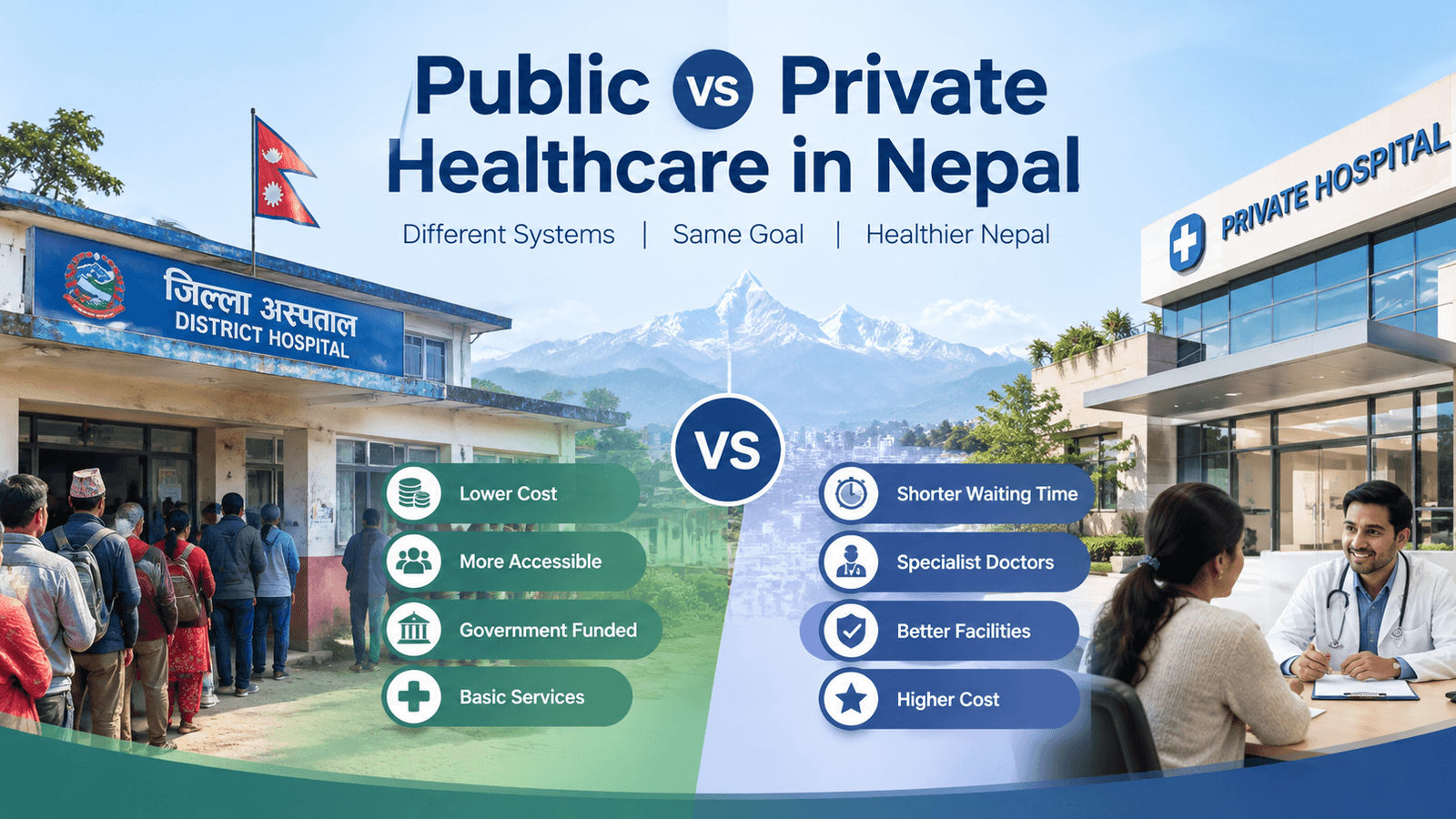
Choosing the healthcare system for treatment is an important decision for many patients and families in Nepal. Public vs Private Healthcare in Nepal is a popular topic for people to discuss when they are trying to decide between government hospitals, private hospitals, clinics, and other medical facilities. The choice can depend on the type of medical care required, cost, health insurance coverage, physician availability, waiting list time, and location, and follow-up care.
Both public and private healthcare facilities are essential components of the healthcare system in Nepal. Public facilities comprise government health posts, primary healthcare centers, district and provincial hospitals, and other government hospitals. Private healthcare facilities include private hospitals, nursing homes, clinics, diagnostic centers, and other non-government health institutions.
However, the choice between public and private healthcare often depends on people’s individual circumstances. Factors that may influence this decision may include the nature of the health problem, location, cost, accessibility to healthcare facilities, health insurance, waiting time, availability of specialists, and many others. Therefore, one healthcare institution may be more appropriate for a particular patient, whereas another facility may be a better option for another individual.
According to the findings of the research published by the Nepal Health Research Council, patients choose to receive treatment in public and private hospitals for different reasons. For instance, based on a study conducted in Tanahu, the relative importance of lower fees or insurance was found to predict public hospital use, while timely services, previous experience, recommendation, and trust predicted private hospital use. The findings also revealed that public and private hospitals could complement each other in providing healthcare services.
This publication aims to discuss the differences between healthcare services provided in public and private hospitals and the factors that patients should consider when making health care decisions.
What Is Public Healthcare in Nepal?
Public healthcare means healthcare services that are provided or managed by the government. In this context, public healthcare facilities refer to health facilities that are managed by the government. Public health facilities exist at different levels ranging from the community to the topmost level.
Public healthcare facilities offer services such as outpatient services, maternal and child health services, immunization, family planning, emergency services, diagnostic services, medicines, and specialist services depending on the level of the facility.
The Ministry has a National Health Facility Registry, which contains a comprehensive list of all government and non-government health facilities in Nepal. The registry provides evidence of the extensive network of health facilities provided by the government in Nepal.
Public healthcare facilities include:
- Health posts
- Basic health service centers
- Primary health care centers
- District hospitals
- Provencial hospitals
- Hospitals managed by the federal government
- Government specialized hospitals
The health facilities differ depending on the level of the facility. A local health facility may offer primary services while a higher-level government hospital offers services including specialist consultations, surgeries, emergency services, diagnostics, and inpatient services.
What Are the Advantages of Public Healthcare?
One of the main advantages of public healthcare is its accessibility. Certain health services are provided free-of-charge or on a subsidized basis by the public system. According to the Nepal Health Facility Survey; family planning and sick child treatment were provided free of charge at public facilities at the level of the district and below. This does not mean that they are always available and accessible, as the availability and utilization of free services can vary by service and facility.
In addition, public facilities can be critical to people living in remote areas since the government healthcare system covers the country at different levels.
Another advantage of public healthcare is the availability of government-sponsored health programs. They provide services such as immunization, maternity care, control of diseases, and education.
However, it is also necessary to note that the experience of care can vary significantly. The waiting time for a consultation, the availability of doctors, medicines, equipment, and specialists can be different at different levels of hospitals and clinics.
What Is Private Healthcare in Nepal?
The term private healthcare refers to medical services provided by private organizations and institutions. It includes private hospitals, clinics, nursing homes, diagnostic centers and other specialized treatment facilities.
Healthcare in Nepal is a blend of public and private facilities. The government acknowledges the role played by private healthcare facilities in Nepal’s healthcare service delivery system.
This type of healthcare facility is more widespread in the capital city and other urban areas. However, there are private healthcare facilities in smaller towns and rural communities as well.
Some of the private facilities provide a variety of services, while others specialize in a certain field. Such services provided by private healthcare facilities may include:
- Private hospitals
- Private clinics
- Nursing homes
- Diagnostic centers
- Specialized clinics
- Private laboratories
- Eye hospitals
- Dental clinics
- Specialty hospitals
It must be noted that services provided by private healthcare facilities vary depending on the organization and its facilities. While some larger private hospitals offer a variety of services and departments, smaller clinics may specialize in one particular service or department.
What Are the Advantages of Private Healthcare?
One of the reasons why some patients choose private healthcare is convenience. In this context, depending on the facilities offered by the institution, a patient can enjoy a convenient appointment system, reduced waiting time, extended opening hours, or access to specific departments or specialists.
A private hospital may offer advanced diagnostic equipment or specialized divisions; however, patients should always verify what concrete benefits and services private hospitals provide instead of the public ones.
Another essential consideration in choosing between private and public healthcare options is the cost. The expenses involved in private healthcare can include consultation, diagnostic tests, medication, accommodation, treatment, and procedures fees. Thus, it is advisable for patients to always clarify what costs are involved in a particular treatment and seek an estimate in case the service is not urgently required.
Public vs Private Healthcare in Nepal: Key Differences
There is no particular provision that distinguishes all public places and private institutions. However, there are several other aspects that patients can consider while seeking healthcare services.
1. Cost of Healthcare
Cost is usually the primary consideration for most patients.
Public institutions tend to provide certain treatments and procedures at subsidized rates or for free depending on the government policies. The eligibility criteria and the services covered differ for every healthcare facility
On the other hand, private facilities charge as per their fee schedule. Patients have to pay consultation fees, lab tests charges, medication costs, procedure fees, and many other hospital charges at private hospitals. It is not always necessary that government hospitals provide free services and private ones charge high fees. Patients should enquire about the fees beforehand to understand what they would be expected to pay.
2. Waiting Time
The waiting time might be one of the essential criteria. Large hospitals with a high number of outpatients can have lengthy queues. However, the waiting time depends on many factors such as the hospital, the department, the day, and the type of visit. Some private institutions tend to offer better appointments and quicker access to treatment. Again, everything depends on the hospital and the place.
Therefore, it is advisable to check in advance whether the desired institution offers an opportunity to book an appointment rather than visiting the hospital without prior registration. Patients should also ask about the estimated waiting time.
3. Availability of Doctors
The availability of doctors may vary depending on the hospital. A public hospital can provide services with the staff of different departments, especially big government clinics. Private clinics also have specialists from various fields of medicine. Instead of choosing the hospital type, one should check if the desired doctor or department is available.
For instance, a person with skin disease may look for a clinic that can cater to dermatology services instead of separating hospitals into private and public.
4. Diagnostic and Laboratory Services
Doctors often prescribe different tests for the diagnosis of a particular case. Both private and public clinics offer a variety of laboratory and diagnostic services. However, the range, hours, equipment, and availability can differ. One should call to inquire about the services provided on the premises.
In some cases, additional testing may be needed, and it is crucial to clarify if the desired test is available for a particular facility or has to be sent to an outside laboratory.
3. Availability of Doctors
The availability of doctors may vary depending on the hospital. A public hospital can provide services with the staff of different departments, especially big government clinics. Private clinics also have specialists from various fields of medicine. Instead of choosing the hospital type, one should check if the desired doctor or department is available.
For instance, a person with skin disease may look for a clinic that can cater to dermatology services instead of separating hospitals into private and public.
4. Diagnostic and Laboratory Services
Doctors often prescribe different tests for the diagnosis of a particular case. Both private and public clinics offer a variety of laboratory and diagnostic services. However, the range, hours, equipment, and availability can differ. One should call to inquire about the services provided on the premises.
In some cases, additional testing may be needed, and it is crucial to clarify if the desired test is available for a particular facility or has to be sent to an outside laboratory.
5. Emergency Services
Emergency care should be differentiated from standard healthcare.
When an emergency occurs, it is essential that patients seek emergency care from the most appropriate facility which requires time, which shouldn't be spent comparing different facilities.
Patients should know which facilities provide emergency services and have the equipment and specialist expertise required.
6. Health Insurance
The type of health insurance chosen by patients can affect the type and amount of reimbursement for healthcare services.
The Health Insurance Board of Nepal administers the government's health insurance program which aims to reduce the financial risk of healthcare costs to the insured. The Health Insurance Board maintains a list of benefits and updates information on service providers and services covered.
The Nepal Health Facility Survey revealed that government-owned health insurance facilities were available at a higher percentage of public facilities than private facilities among the hospitals and primary healthcare centres surveyed.
Patients with health insurance should verify whether the facility is an approved provider and the services included in the package.
Furthermore, it is essential to understand the specific requirements for referrals, copayments, services not covered and other insurance details before receiving care.
7. Location and Accessibility
The location of a healthcare facility may be extremely important.
Having the healthcare facility nearby could be more appropriate for consultations, follow-up appointments, and emergencies. It would be hard for older people, children, people with disabilities, or receiving treatment to travel several hours for any given appointment.
Various factors such as distance, transportation, road conditions, parking, and accessibility should be taken into consideration when selecting a healthcare facility.
Does Private Healthcare Always Mean Better Healthcare?
Not necessarily. Private and public healthcare facilities may differ significantly in terms of staffing, equipment, services, management, waiting time, and overall experience. Ownership is not always an indicator of the quality of care provided.
Although private hospitals may offer convenience, this does not necessarily mean that they are the best option for all medical conditions. In the same way, public hospitals may provide highly qualified specialists and essential facilities, although with a higher wait time.
Patients should assess the services offered, the personnel involved, the facilities provided, costs, and their individual healthcare needs.
The Ministry is responsible for regulating, monitoring, and evaluating health institutions, including government hospitals and private nursing homes and hospitals.
Does Public Healthcare Always Mean Lower Quality?
Public healthcare should not be evaluated solely on the basis of ownership. Government hospitals and health institutions provide a wide range of essential services from preventive healthcare, emergency care, specialist treatment, maternal and child healthcare, and other medical services.
Although some public hospitals are large referral centers that offer specialized treatment not available in smaller facilities.
At the same time, public facilities can have a high patient ratio, insufficient resources, long waitlists, or other challenges that may affect the quality of care or access to services, which can vary from one region to another.
As such, patients should consider the specific healthcare facility and service they need instead of basing their decision solely on the ownership status of the facility.
How Should Patients Choose Between Public and Private Healthcare?
Patients can consider the following aspects before choosing healthcare facilities.
Consider the Type of Medical Problem
A simple health concern can be addressed at a nearby primary healthcare facility or clinic whereas a complicated problem may require a specialist or hospital. In case of a chronic condition, patients should consider whether the facility can provide regular follow up care.
Check the Doctor's Qualification
The qualification and registration of healthcare professional is always an important consideration. Patients can check whether the medical doctor is registered with the Nepal Medical Council when appropriate. The registration is an important verification measure but it should not be looked at as guarantee of a particular treatment outcome.
Check Available Services
It is essential to check the services that the facility offers before going there. This will help to save time by avoiding the need to go back to the same place more than once. Checking the available services may also help to know what to do if something goes wrong without needing to go to another facility. The services one should ask about include:
- the required medical department,
- laboratory,
- imaging,
- emergency care if required,
- pharmacy,
- specialist consultation,
- follow-up care.
Ask About the Cost Involved
It is crucial to inquire about the cost involved for the services mentioned above. Where payment is required, the patient should know the amount charged for a single consultation, diagnostic tests, procedures, drugs, or room fees. On the other side, patients should ask what services are free or subsidized in the public sector or covered by insurance and those that are not. It will also help to have an idea of all the expenses incurred in caring for the sick.
Check Insurance Coverage
If you have health insurance, you need to check whether the facility accepts your insurance and whether the service you need is covered by the plan.
The Health Insurance Board's latest information on benefits should be consulted because coverage, participating facilities, and terms and conditions can change.
Public vs Private Healthcare for Different Situations
Different situations require different considerations.
For Routine Checkups
For routine health checkups, patients may look into their nearest public health facilities, private clinics, or hospitals, depending on the services needed.
Convenience, cost, doctor availability, and follow-up options can aid the decision-making.
In addition, regular checkups can help detect specific health problems early in addition to having the opportunity to talk to a qualified healthcare professional about their preventive healthcare needs.
For Specialist Consultation
When a specialist consultation is necessary, determine what type of medical specialty is needed to address the condition.
For instance, a patient may need a dermatologist for skin ailments or a cardiologist for heart conditions.
In such a case, the accessibility and expertise of the right specialist may matter more than the distinction between a public or private facility.
For Emergency Care
For emergency care, seek the appropriate medical attention as soon as possible.
It is crucial to have a list of nearby hospitals that offer emergency care.
If the closest emergency facility to their location is a public hospital, private hospital or another kind of institution, getting timely care should be their top priority.
For Long Term Treatment
There are patients who need regular checkups, numerous tests, intake of several medications, and the like during their treatment.
Thus, for such category of citizens it is essential to take into account such factors as:
- distance from one’s home,
- doctors’ availability,
- cost,
- insurance coverage,
- accessibility of drugs,
- diagnostic services,
- subsequent follow-up
Therefore, it is crucial to choose a suitable and convenient for a client facility which will provide all necessary services on a continuous basis.
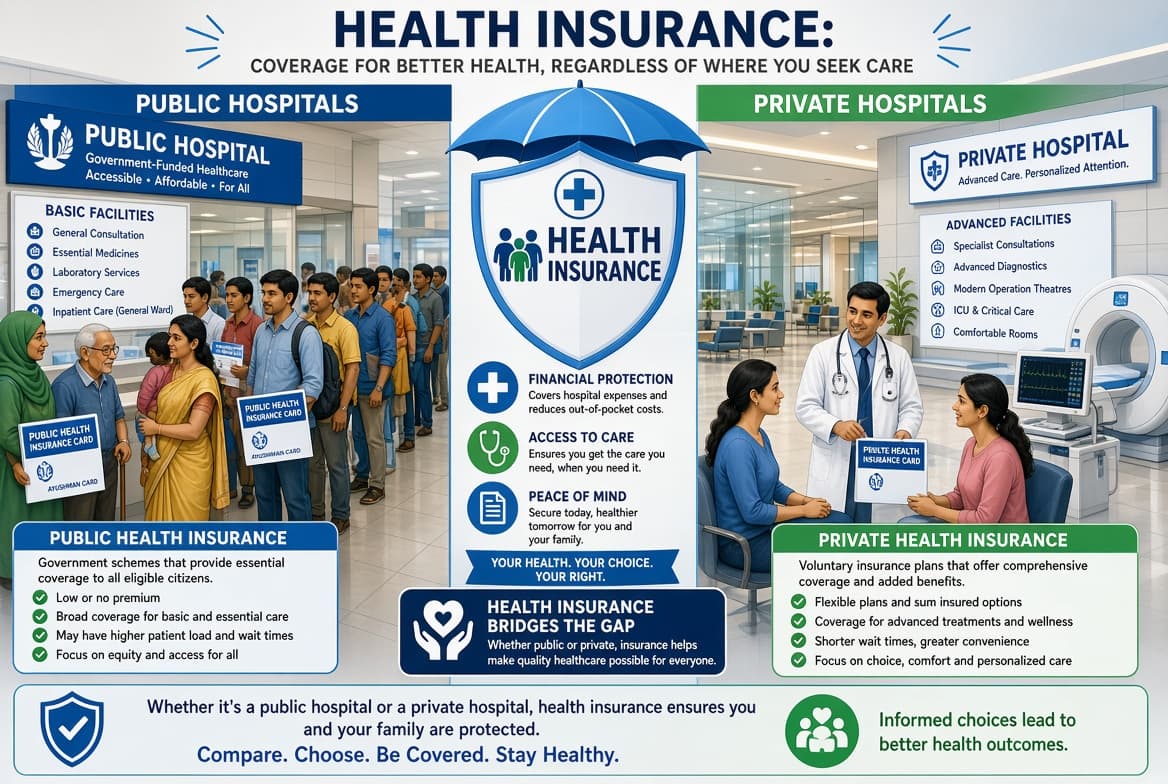
What About Health Insurance in Public and Private Hospitals?
Health insurance can help you minimize the costs of medical care in Nepal. Both private and public hospitals can be involved in the insurance system of the Nepalese government, but the list of services covered by insurance is different for each institution. It is important to research and find out which health insurance funds and policies cover a particular type of medical treatment in a selected hospital to minimize costs.
In addition, it is necessary to clarify whether the desired procedure requires a referral, which services are included in the benefit package, and the share of costs incurred by the insured. This will help avoid unwanted expenses during treatment.
Public and Private Healthcare Can Work Together
Public and private healthcare should not be considered as two separate entities that contradict each other.
Both sectors play a significant role in Nepal’s healthcare system and should operate in parallel to provide the best services.
Public healthcare refers to the essential healthcare services, prevention, government-sponsored initiatives and programs, and affordable treatment. Private healthcare includes hospitals, clinics, specialists, diagnostic services, and treatment. The research conducted in Nepal concluded that public and private hospitals have an inverse relationship and different determinants that contribute to a person’s choice between them.
Thus, the critical question for a patient with a particular request, geographic location, budget, and follow-up care needs is not which one is better, but which one suits their needs better.
Conclusion
Public versus private healthcare in Nepal is not a choice between cheap and expensive healthcare; rather, it is a choice between traditional and modern healthcare. Both sectors offer vital services, and the experience may differ significantly between individual hospitals, clinics, doctors, and locations.
The public and private healthcare systems may provide distinctive options for scheduling an appointment, visiting a specialist, being treated in a particular room, and other facilities that a private hospital can afford. However, these opportunities are not a must for every hospital, clinic, or physician. Therefore, when choosing between private and public healthcare, a patient should consider the scope of medical problems, staff qualifications, services offered, fees, insurance coverage, location, waiting time, emergency treatment, and follow-up care.
Most importantly, a patient should put a priority on getting proper treatment from qualified personnel. By making informed decisions, patients will get value for their money both in the public and private healthcare systems. Thus, a strategic choice of healthcare providers will increase the efficiency of service delivery and help patients navigate the healthcare system in Nepal.
For patients who prefer to receive access to healthcare information and scheduling appointments conveniently, UpcharSewa can bring healthcare facilities closer to people and promote the concept of healthcare in your pocket, makes it easier to find healthcare professionals and appointment options by helping them find an NMC-Verified Doctor.
Frequently Asked Questions
What is the difference between public and private healthcare in Nepal?
Public healthcare refers to government-run health facilities, whereas private healthcare refers to privately owned hospitals, clinics or healthcare centres. The difference can include cost, waiting time, availability of services and appointment options.
Is public healthcare cheaper than private healthcare in Nepal?
Public healthcare may be more affordable for certain services as some government supported services are free or subsidised, whereas private healthcare facilities require payment for consultations, tests and treatment.
Are private hospitals better than public hospitals in Nepal?
There is no definitive answer as it may vary from hospital to hospital. The quality and availability of services may vary between facilities, so patients must evaluate doctor qualifications, services available, cost, location and their healthcare needs.
Can I use health insurance in both public and private hospitals?
Yes, government health insurance services may be available through both public and participating private healthcare facilities. Patients should check if the specific hospital and service they need is covered before seeking treatment.
How can I choose between a public and private hospital in Nepal?
Evaluate your medical needs and budget, health insurance coverage, location, doctor availability, waiting time, diagnostic services and follow up care options. In case of emergencies, seek appropriate medical attention without delay.
Can I find an NMC-verified doctor in Nepal?
Yes, you can check whether a medical doctor is registered with the Nepal Medical Council. UpcharSewa can also help patients discover doctors and healthcare appointment options.
Which is more suitable for regular health checkups, public or private healthcare?
Both public and private facilities may offer regular health checkups. The choice may depend on the available services, cost, location, doctor availability and insurance coverage.
What should I check before visiting a hospital in Nepal?
Check if the hospital can provide the service you need, the availability of the required doctor, consultation and treatment costs, insurance coverage, opening hours and follow up options.