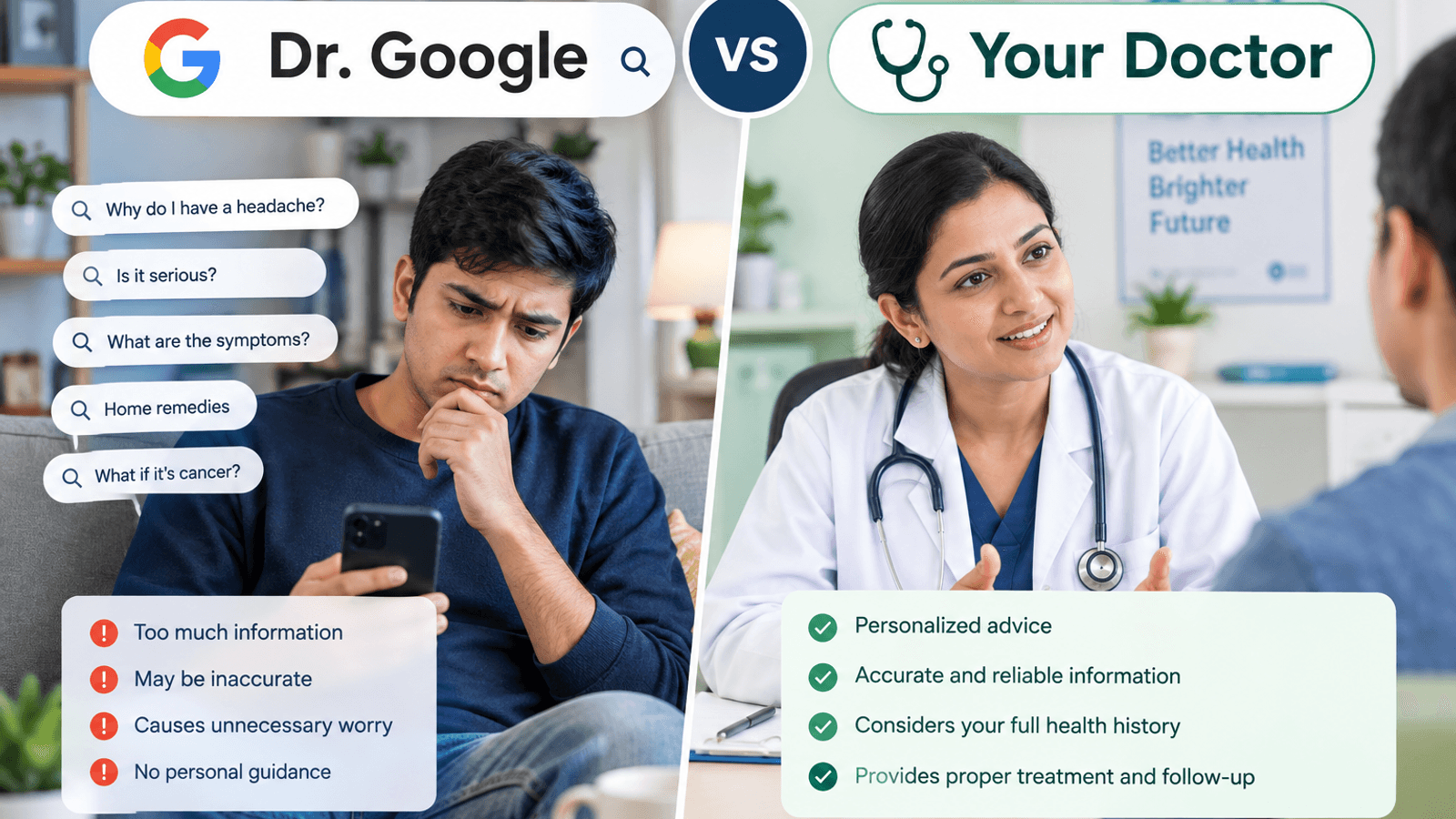
When you have a health concern, researching your symptoms online can provide you with information on the topic quickly. However, Dr. Google vs. Your Doctor is an important distinction to make because when it comes to health issues you can't always rely on what you find online to be accurate for your individual case. Google can provide you with information that may help you understand what is happening in your body, but your doctor can assess your symptoms and health needs more specifically before recommending any treatment options.
Researching one's health issues might be quite helpful in certain ways. For instance, people might learn more about specific medical terms, general information about their possible illness, ways to prepare for the appointment with healthcare providers, and what to ask them. However, since search engines cannot see the whole medical history of an individual, assess the physical examination, consider the list of drugs a person is taking or has prescribed, and take into account other individual factors, they should be used carefully. One should not let the results found online replace the thorough examination by a qualified doctor. With the proper use of the Internet, people might benefit from researching their health issues not being overwhelmed with too much information and being misunderstood. This is where the case of Dr. Google vs. Your Doctor comes in.
What Does “Dr. Google” Mean?
“Dr. Google” is an expression that refers to a practice of doing a web search to get answers to medical questions. So, it does not refer to an actual human being. The name is given to the concept of using internet resources to research health-related issues.
The examples of such search queries are numerous, as they can start with a person’s health concern. For instance, “what are the causes of headache”? As a result, one would find common causes such as fatigue, dehydration, lack of sleep, stress, infection, migraine, and many others. Among those causes, some might be serious, and most of them would seem irrelevant to the person, as each case is unique and depends on many factors.
Therefore, web searches are useful tools in understanding one’s health problems and preparing questions for a professional. However, they should not replace medical service by themselves due to possible biases and errors.
Why Do People Search Their Symptoms Online?
Several factors contribute to people’s decision to go to the Internet when they suspect something is wrong with their health.
It Is Fast and Convenient
Information can be found on the Internet at any time, regardless of the person’s schedule. This is especially valuable when one does not have to wait for an appointment to obtain the most basic information about their health problems.
People Want to Understand Their Symptoms
Medical terminology can be baffling for the untrained person. Researching one’s symptoms can often help them sort through the chaos and make a list of relevant questions for the medical professional.
People Want to Know Whether They Should Seek Care
Sometimes people do not realize that the symptoms they experience should be addressed by a medical professional. Reading about similar signs and symptoms can often open their eyes to the fact that medical care is necessary.
People Want to Prepare for an Appointment
Sometimes people conduct research before having an appointment with a healthcare professional to equip themselves with relevant information about their issues. This can save time and provide the healthcare professional with a clear starting point.
It has been established that seeking information on the Internet influences people’s perception of their symptoms as well as their interaction with the healthcare system. It can help people conduct a self-assessment, which can be beneficial in some cases and detrimental in others.
What Can Online Health Searches Do Well?
Online health information is not always bad, but the information on the websites should be reliable and trustworthy.
Learning Health Information
Healthful Websites can help you learn about different kinds of health issues, their medical terms, ways to prevent them, how to take care of yourself, and ways to treat them.
Learning Medical Terms
A reliable source can help you understand most medical terms a physician may use. If you don't understand a medical term your doctor is using, you can look on a reliable source and be able to understand what it means.
Asking Questions to A Doctor
Being able to read about health issues can help someone know what questions to ask a doctor about a health issue they may be facing.
Healthful Resources
The internet can lead you to reliable sources, hospitals, organizations, medical institutions, and official sites endorsed by government agencies.
The World Health Organization suggests looking at who has contributed to the online resource, has the website got any endorsements, is the information up to date, and does the site give references to other websites or journals.
Dr. Google vs. Your Doctor: What Is the Difference?
The most significant difference is that online search results provide general information whereas a doctor can evaluate an individual's health situation.
Online Searches Provide General Information
A search engine provides information based on what an individual types into it. It does not conduct a physical examination or independently verify the individual's symptoms.
For instance, if two people were to type in "stomach pain", then their symptoms might be similar from the search engine's perspective on the issue but have different root causes.
The search results would not fully reflect the difference between the two individuals' health situations.
Doctors Evaluate the Individual
In a medical consultation, a Doctor can ask questions to determine the person's symptoms, medical history, medications, previous conditions, and other information. Based on this information, a healthcare professional may conduct an examination or appropriate tests for the case.
This additional information enables the healthcare professional to evaluate the situation more specifically.
Doctors Can Ask Follow-Up Questions
A search engine typically responds to the information typed in by the user. A Doctor can ask further questions if something is unclear or necessary.
For instance, a Doctor might ask for the time of occurrence of a symptom, whether it is getting better or worse, other accompanying symptoms, and any relevant previous cases.
This additional information may be important when determining the health situation.
Doctors Can Consider the Whole Situation
Health situations do not always follow a specific list of symptoms. A Doctor considers symptoms alongside the person's history and other information.
This is why a search online should not replace professional evaluation in the case of a person's health concerns.
Why Searching Symptoms Online Can Sometimes Be Misleading?
One of the main challenges in searching the web for possible causes of one's symptoms is that any given symptom can have a wide range of potential causes.
The Same Symptom Can Have Different Causes
For instance, tiredness can have a range of different causes. Searching "tired all the time" can yield you a long list of possible conditions and diseases.
Noticing a disease on an online search result does not necessarily mean that it is the cause of your symptoms.
Search Results May Highlight Serious Conditions
A search engine might give you information on a serious disease, simply because it contains some of the same symptoms or keywords as your own.
This can lead to an overestimation of the danger of one's symptoms, if one is not careful.
Online Information May Lack Context
A website's article on a certain health topic may not contain enough information to apply it to a person's specific case.
Without sufficient context, general information can be mistaken by people for something specific.
Different Websites May Give Different Information
Not all health-related websites are equal - some offer more quality information than others. Not all websites are written by qualified doctors, and some may even offer misleading opinions, out-of-date information, or faulty unverified claims
The WHO advises to look at the source, author, date, references and intent of a source before taking it as credible information.
What Is Self-Diagnosis?
Self-diagnosis is when a person tries to identify their health issue without a proper examination from an appropriate professional.
Searching online doesn't necessarily mean one is self-diagnosing. A person could be doing a general search for health information without determining they have a specific disease. However, treating an incidental search result as a diagnosis can be problematic.
For example, saying a specific symptom can be produced by a disease doesn't necessarily mean that the person has the disease. A person would have to go through a comprehensive history or other methods of diagnosis depending on what's warranted.
Review literature of online symptom checkers have shown that their diagnostic accuracy vary greatly between checkers, and overall have low diagnostic accuracy, and therefore should not be used as a substitute for proper diagnosis.
Can Online Health Information Be Helpful Before Seeing a Doctor?
Yes, through the mindful use of online information, one can educate themselves to be a better healthcare participant.
Writing Down Symptoms
Instead of doing multiple searches for potential illnesses you may have, write down symptoms as they happen.
You can write down when the symptom began, how often it occurs, if it's worse at some times than others and if anything else happens at the same time.
Asking Questions
The information found can also be used to ask your healthcare provider questions.
Having a list can help jog your memory and pique your interest, and bring along any clarifications for better communication.
Medical Language
Looking up medical language in a reliable resource can also educate you on medical language.
If you understand the language, it could make communicating with your healthcare provider less challenging.
Trusted Source
Seeking information from trusted sources like hospitals, official health organizations, government agencies, universities and medical schools, and other healthcare providers is the key.
Most of the time, the best resources don't come up on the first search, so don't settle on the first few results that show up.
How to Identify Reliable Health Information Online?
Not all websites providing health information are created equal.
Check who has prepared the information
Reputable health organizations will normally provide information about themselves, so it should be possible to find out who has prepared the website and what they claim.
Check the date of publication
Health information is often changing and evolving, and it is important to make sure that the information reflects the most recent research and treatment guidelines.
Check that the information includes references
Trusted health sites will typically include references or provide enough information so that you can find the source of specific information or claims.
Be wary of sites that make specific claims
Health care is not simple, and there are rarely easy answers.Never rely on a single source of health information.
If the information is important to you, always seek a second opinion, from another reputable source. WHO advises considering the source, credibility, date of publication or last update, references, and purpose of information provided on health websites.
When Should You Stop Searching and Talk to a Doctor?
Online searching should not become a replacement for professional healthcare. Seeking advice from a qualified healthcare professional should be done if a health concern is persistent, worsening, unusual, or extremely worrying.
A healthcare professional can help assess what information applies to the individual's situation. It is also important not to ignore professional healthcare advice if an online search suggests a symptom is innocuous, since online information cannot fully evaluate an individual's condition.
If symptoms seem severe, or if there is an emergency, appropriate care should be sought immediately instead of relying on an online search.
The intent of online resources is to aid in understanding, and shouldn't deter people from seeking medical attention if required.
Why Repeated Symptom Searching Can Increase Anxiety?
Searching symptoms online can exacerbate worries of people. A person can start out with one set of symptoms, find multiple theories as to what it is, and then individually search each theory out. This can create an endless loop of searching.
This does not mean that there aren't any redeeming qualities to searching out symptoms. Research has shown contrasting results, and can help people feel more prepared or educated. However, if used too much or in the wrong way, it can lead to people feeling more anxious or uninformed.
A better way to combat this would be to use it for educational purposes and not to endlessly research out symptoms and possible diagnoses.
How to Make the Most of a Doctor Consultation?
Instead of spending a lot of time searching a question on the Internet, try to prepare relevant information for the healthcare professional.
Clarify the Major Issue
Begin with providing the major symptom or concern in simple words.
Clarify When It Began
Tell the doctor or nurse when you first noticed the issue and whether it has changed since then.
Specify if There Are Other Symptoms
If you have other symptoms, specify them as well.
Provide Relevant Medical Background
Make sure to share relevant personal medical background, including issues, medications, allergies, and so on, and respond to specific questions they may have.
Ask Inquiries
Do not forget to ask clarifying inquiries if something is unclear to you. A doctor’s appointment is not only for getting answers but also for sharing your major concern and clarifying what has to be done next.
Should You Stop Using Google for Health Information?
No, I don't think that the aim is to totally discourage people from using the internet.
The internet can be good for providing health information and educating people, but it is good to be careful and not just assume something is correct.
For example searching for what high blood pressure means is great, but looking up how you have high blood pressure is bad.
The internet can make you more aware, but a medical professional would do a better job at analyzing your health.
Can Online Health Searches and Doctor Consultations Can Work Together?
It does not have to be Google vs. your doctor. The alternative is to use both as they are intended. The two can go hand-in-hand.
Use Online Searches For:
- To educate yourself
- Become informed
- Find educational resources
- Ask questions
- Learn of other general health practices.
Use a Doctor Consultation For:
- Give them your symptoms
- Give them your pertinent medical history
- Get an individualized assessment
- Learn if there is a need for additional work-up
- See what the next steps are.
Common Mistakes People Make When Searching Symptoms
Assuming the First Result Is Correct
While search ranking may indicate popularity, it does not necessarily mean medical accuracy. It is important to look further than the top result and analyze the source.
Assuming That a Particular Symptom Is Connected to Only One Possible Diagnosis
There might be multiple reasons for the particular symptom or set of symptoms that one is trying to research. One should not jump to conclusions just based on one piece of information.
Reading Only the Most Fear Creating Options
Some sites will lead one to believe that they have a particular diagnosis based on the severity of the symptoms, even though those might not be the most common reasons for those symptoms.
Ignoring Professional Advice
If a healthcare professional provides advice that conflicts with what one has read online, it is important not to assume that the internet is always right. One should instead talk with their healthcare professional about the concern and ask about the information found online.
Spending Too Much Time Searching Instead of Talking With a Professional
Trying to research the same set of symptoms over and over again can confuse one more than help them.
How UpcharSewa Can Help?
Finding the right healthcare professional can sometimes seem challenging, particularly if you are not quite sure where to start
With UpcharSewa you can simplify the process of finding healthcare services by helping you find doctors and healthcare providers.
Rather than spend hours trying to research a diagnosis on the Internet, you can rely on credible health information to learn more about your concerns and then move on to consulting with the appropriate healthcare professional.
You can also connect with UpcharSewa to access valuable resources about NMC Verified Doctors in Nepal, learning more about the importance of consulting with registered medical professionals.
Online health information and digital healthcare services can work hand in hand. The Internet can help spread awareness, while healthcare professionals can help provide each individual with the medical care they need.
Conclusion
The advent of the Internet and modern technology has changed the landscape of health care. Today, patients are more informed than ever before. With just a few clicks on Google, they can go from feeling anxious about an unusual symptom to thinking that they understand what that symptom means based on the information that they found online. But what about the subtle differences between one individual's medical predicament and another's? Search engines are not always precise enough to be able to make a distinction between common symptoms that affect the general population and special cases that require a more in-depth analysis.
The main takeaway from Dr. Google vs. Your Doctor is not that getting health information online is a bad idea, but rather that there is an important place for such information in the overall health care economy, and it does not involve asking a search engine to substitute itself for an actual medical professional based on a couple of symptoms.
Instead, using such resources as an educational tool to get more informed, to understand certain terms, to ask better questions, and to get more involved in your own health care is the right way to use these technologies. When it comes to your own medical needs, keep in mind that your search engine cannot ask as many clarifying questions as a qualified medical professional would, analyze your symptoms in the context of your overall medical history, and prescribe a solution that actually works.
Frequently Asked Questions
Is it a good idea to Google my symptoms?
Yes, if you are searching for general health information and you use credible sources, but you shouldn't expect search results to give you a personal diagnosis.
Can Google search help diagnose a disease?
No, a search engine isn't capable of diagnosing individuals, it can only provide information based on what you are looking for.
Are there any online tests that can help determine possible illnesses?
There are many different websites that feature different symptoms checkers, however, studies have shown that their diagnostic and triage accuracy is highly variable, so they shouldn't be relied on completely.
Should I inform my doctor about what I find?
Yes, if you found something that you are concerned about it is best to bring it up, a professional can tell you if what you found applies to your specific case.
How can I ensure that the information I find is accurate and credible?
By looking for information on government health related sites, hospitals, universities, and other credible medical organizations. You should also consider why the information is there, who put it there, and when it was last updated.
Is health information found online a substitute for a doctor?
No, health information found online is just that, information. A doctor is required for any kind of personal diagnosis.