Sometimes when you get a new diagnosis or are told that you may need a significant treatment, you want to know more. You may want to learn more about your diagnosis, understand your treatment options or just feel more confident about the upcoming treatment. That is why you might want to seek a second medical opinion.
According to the WHO, when seeking a second opinion, patients should ask for it in order to make an informed decision regarding their diagnosis, course of treatment, and the risks and benefits of that treatment.
A second medical opinion is when you consult with a different trusted medical professional about your diagnosis, testing, test results or proposed treatment. He or she will look at your specific case and give you their personal opinion. Getting a second opinion does not mean that you think your doctor is wrong, but that you want to hear from another doctor, as they may have different areas of experience and expertise.
For patients in Nepal who need to find the right medical care and research options, it can be challenging to find the right doctor. Fortunately with the help of services like UpcharSewa, patients can find medical professionals and facilities to help them weigh their options and get the care they need.
What Is a Second Medical Opinion?
A second medical opinion is an evaluation of another qualified physician after receiving initial diagnostic conclusions or treatment recommendations.
For example, if a doctor recommends a specific procedure, a patient has the option to consult another medical professional to discuss the risks, benefits and potential alternatives. Both doctors can evaluate the patient’s diagnosis, test results and any other relevant factors.
A second opinion can confirm the initial diagnosis, suggest an alternative diagnosis, recommend a different course of treatment or provide additional insight into why the first recommended option may be needed.
It is important to remember that a second opinion request is not about finding a better doctor than the first one but seeking guidance on your overall health care needs.
Why Do Patients Seek a Second Medical Opinion?
Patients seek second opinions for many reasons. Some people just want reassurance. Others may have a complicated diagnosis or were given multiple treatment options.
To Confirm a Diagnosis
One reason someone may seek a second opinion is to confirm a diagnosis.
Sometimes people have health issues which present similar symptoms. A physician will use the patients symptoms, physical examination, medical history, and diagnostic testing to formulate a diagnosis. Another physician may look at the same information and offer additional insight. A second opinion can also help determine if additional testing or a specialist referral is needed.
However, a second opinion is not guaranteed to change the diagnosis. The second opinion doctor may agree with the original diagnosis.
To Understand Treatment Options
Sometimes there is more than one way to treat a medical condition.
Depending on the diagnosis, treatment options may include medication, making lifestyle modifications, undergoing a procedure, surgery, radiation, receiving monitoring, or physical therapy. Sometimes a combination of treatment options is necessary. A second opinion physician can help explain the available treatment options and the potential risks, benefits, and expectations associated with each. This allows the patient to have a more educated discussion with their physician about which option is best for them.
Before Major Surgery
A second opinion can be helpful in the case that a patient is considering a major procedure or surgery.
Surgery requires patients to make many important decisions. Having a second physician discuss the risks and benefits can help someone decide if surgery is right for them. A second opinion helps the patient understand why the surgery is recommended, and what other options may be available to them. This does not mean that surgery should always be avoided, but rather helps the patient make an educated choice.
When the Diagnosis is Complicated
Some conditions can be harder to diagnose.
If symptoms are not classic for one diagnosis or test results are conflicting, another physician can help determine if further investigation is warranted. A second opinion physician may be able to order additional testing if indicated. For more complicated diagnoses, a specialist in a particular field may also be helpful.
When You Have Questions
Sometimes the reason for seeking a second opinion is simply because patients have questions.
Sometimes patients do not completely understand their diagnosis, the treatment plan, medications, or follow up. Rather than attempting to make important healthcare decisions whilst confused, sometimes patients benefit from having their questions asked by another physician. It is important to ask questions and seek clarity if you are ever concerned.
Does Getting a Second Opinion Mean the First Doctor Was Wrong?
No. Getting a second opinion doesn't always mean the first doctor was wrong.
Medicine can be unpredictable, and it's possible for patients to display similar symptoms and for there to be multiple possible treatments. Two different doctors could give conflicting recommendations.
A second opinion can help you make sure that the treatment plan is right for you.
If the two doctors agree, you can feel reassured that the treatment will be effective. If the two doctors disagree, you can ask each of them to tell you why they believe their recommendation is best. You should listen to what the doctors have to say and make your own decision based on their advice, not on who is right and who is wrong.
When Should You Consider a Second Medical Opinion?
There is no one-size-fits-all rule, but there are definitely some instances in which patients should seek a second opinion.
When A Patient Receives A Serious Diagnosis
Sometimes, it's just too overwhelming to deal with a serious or life-altering diagnosis. It can take time for patients to come to grips with their condition and what treatment options are open to them.
Seeking out another medical professional to help explain their diagnosis and options can be helpful in finding the right solution.
When Major Treatment Is Recommended
If you're being recommended for a major procedure, surgery, or course of treatment, you may wish to know more about why it's needed and what options are available.
Seeking a second opinion could help answer these questions.
When You Are Unsure About the Treatment Plan
If you don't understand why a certain treatment is being recommended, ask questions until you do. If you still have questions after that, consider getting a second opinion from another physician.
When Symptoms Persist
Sometimes, the problem is that a person keeps having symptoms even after being treated. There may be numerous explanations for why this occurs. Additionally, it is critical that the medical professional re-examines the patient's medical records, diagnosis, and tests.
As a result, there is no doubt that seeking a second opinion from another qualified physician can be beneficial.
When There Are Numerous Treatment Avenues
Furthermore, if your doctor presents you with various treatment options, requesting a second opinion will allow you to fully grasp the varying degrees of each choice.
As a result, you will have a better understanding of the risks, advantages, recuperation period, and any further treatment that may be required.
Benefits of Getting a Second Medical Opinion
There are several reasons a second medical opinion could benefit you.
Better Understanding of Your Condition
By talking to another doctor, you may get a more comprehensive understanding of your diagnosis.
- you can have the doctor clarify
- what the diagnosis means,
- what caused it,
- what tests have been done,
- what tests are needed,
- possible treatments and any other necessary follow up care.
A better understanding of your diagnosis could make conversations with your doctor easier to understand.
More Confidence in Your Decision
Sometimes medical decisions can be stressful.
If another qualified doctor reviews the diagnosis and offers another opinion, you will likely feel more confident about the decisions you make regarding your health care
If both doctors agree on a treatment plan, you can be extra sure that it is the best option for your specific case. If they disagree, you can ask plenty of questions to help you reach a better decision for your unique needs.
Discovering Other Treatment Options
Another doctor can tell you about other treatment options you didn't know about.
It doesn't mean that their option is better, but it can open your eyes to more possible options to talk over with your doctor.
Finding the Right Specialist
Getting a second opinion can also help you find the right specialist for your needs.
Different doctors have different fields of expertise. If you have a particular medical problem, you'll want to see a doctor with special training and experience in that area.
How to Prepare for a Second Medical Opinion?
Good preparation can make your second consultation more productive.
Get Your Medical Records Together
Before consulting another doctor, it is important to get together the various medical information relevant to the situation.
This can include things like:
- prescriptions
- test results
- imaging results
- medical history
- discharge notes from hospital visits
- notes from previous consultations
- a list of current medications
You probably do not need to bring all medical notes and records that you have, just those that pertain to the issue at hand.
Write down your symptoms
Make a simple note of your symptoms, including things like when they began, if they have changed, or anything that makes them better or worse.
Having this information written down can help jog your memory if needed.
Make a List of Questions
It is common to miss some questions while consulting a doctor. Therefore, it is essential to make a list of questions that one would like the doctor to answer. The following are some of the questions that one should ask the doctor:
- What does the diagnosis mean?
- Is there an alternative explanation for the symptoms?
- What are the available treatments?
- What are the benefits and risks of the proposed treatment?
- Are there additional tests that need to be taken?
- What are the effects of postponing the treatment?
- What is the follow-up care after the treatment?
Be Honest with the Second Doctor
One should be open with the second doctor regarding the diagnosis and the recommended treatment. It is vital to give accurate information regarding the diagnosis and treatment. One should also present relevant reports to the second doctor. This helps the second doctor to make better decisions since he/she will not base his/her recommendations on incomplete information.
How to Find a Doctor for a Second Opinion?
Finding a suitable doctor can be an important part of seeking a second opinion.
Check the Doctor's Qualifications
Look for qualified and registered healthcare professionals.
In Nepal, patients can use the Nepal Medical Council (NMC) resources to check the list of registered medical doctors and verify the required information. Patients should keep in mind that the doctor's registration confirms his/her professional registration, but it does not guarantee a particular treatment result.
Consider the Doctor's Specialty
Try to find a doctor whose specialty area matches the nature of patients' health concern.
For example, patients with a particular medical condition may benefit from consulting the appropriate specialist rather than any available doctor.
Consider Accessibility
Think of practical factors such as location, appointment availability, consultation method, and follow-up.
An online consultation may be convenient for some patients to discuss specific concerns. However, an online consultation cannot replace an in-person examination when physical examination, diagnostic testing, or urgent care is required.
Use Trusted Healthcare Platforms
Healthcare platforms can help you find it easier to discover doctors and healthcare services.
UpcharSewa helps patients explore doctors and healthcare providers so that they can find appropriate healthcare services based on their requirements.
What Questions Should You Ask During a Second Opinion?
A second consultation is a good opportunity to ask questions.
Ask About the Diagnosis
Ask the doctor to explain the diagnosis in simple language
You can ask:
“What does this diagnosis mean for me?”
You can also ask whether there are other possible explanations for your symptoms.
Ask About Treatment
If treatment has been recommended, ask why.
Useful questions include:
“Why is this treatment recommended?”
“Are there other treatment options?”
“What are the possible benefits and risks?”
These questions can help you understand your choices.
Ask About Additional Tests
Sometimes another doctor may recommend additional testing.
Ask why the test is needed and what information it is expected to provide. Not every patient needs additional testing, so testing decisions should be discussed with a qualified healthcare professional.
Ask About Follow-Up Care
Healthcare does not always end after diagnosis or treatment.
Ask how often you should return, what symptoms you should monitor and what follow-up care may be needed.
What If the Two Doctors Give Different Opinions?
Sometimes, two doctors can give two different opinions on the same topic. This might be confusing to the patient, but it doesn't necessarily mean that either of the doctors are wrong.
Different opinions can stem from symptoms, medical history, test results, age, other illnesses and a doctor's personal evaluation
Ask Both Doctors Why They Recommended Something
If the two doctors recommendations differ, you should ask each doctor why they recommended what they did. You can ask them to talk through what information they used to come to the conclusion and why they think it's right for you. This helps you understand each others points of view and helps you have an educated discussion with your doctor.
Review Your Medical Reports
Ensuring that both doctors have all the relevant information on hand, including test results, previous prescriptions, scans, and medical history. Sometimes a doctor may need more information in order to determine a diagnosis, and providing them with all of the information they need is always the best option.
Ask if They Need More Information or Tests
Depending on your diagnosis, your doctor may require additional information or tests in order to further determine what the problem may be. Ask if they would like a second opinion from a specialist, or if they would like you to take any additional tests. Do not request tests just for the sake of getting an alternate diagnosis, instead, ask your doctor what benefit an additional test would provide.
Consider Consulting an Appropriate Specialist
If the situation is complicated or the options are conflicting, an appropriate specialist may be able to offer additional insight. The type of specialist will depend on the issue. This professional can evaluate your medical history and available reports and explain the possible approaches.
Take Time to Understand Your Options
When the situation is not urgent, you may have time to understand your different options before making a choice. Put together a list of the main differences between the options and ask questions about the possible benefits, risks, and follow up required for each.
The purpose of getting a second medical opinion is not to find the doctor that will tell you what you want to hear. The purpose is to understand your situation and the available options as best as possible so that you can discuss the next steps with a qualified medical professional.
Can You Get a Second Medical Opinion Online?
In certain cases, virtual healthcare services can facilitate communication with another physician. They can be used to discuss symptoms, health history, reports, prescriptions, and other common questions.
There are limitations to online consultation. Consultation through the internet is not appropriate for those who need a physical examination, diagnostic tests, imaging, or immediate care.
Patients are encouraged to determine the most appropriate mode of consultation based on individual health needs and the recommendations of qualified healthcare professionals.
Second Medical Opinion vs Changing Your Doctor
Getting a second opinion does not always mean that you have to dismiss your doctor. A patient can get a second opinion from another doctor and then go back to their first doctor.
For example, you could ask another doctor about a treatment option, learn about it, and then go back to your original doctor and share what you learned. The second opinion could be used as a discussion point from the patient to converse with their first physician.
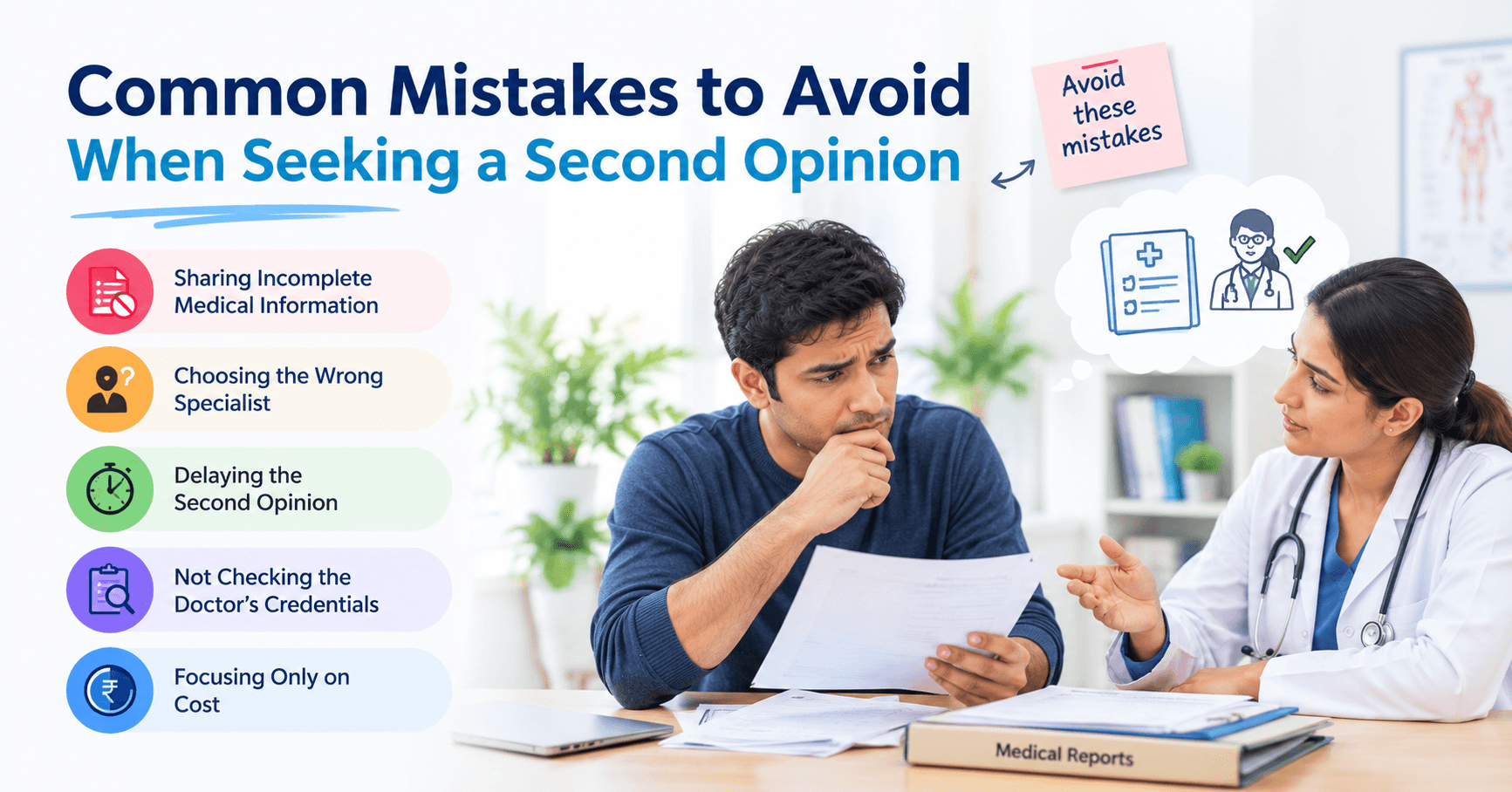
Common Mistakes to Avoid When Seeking a Second Opinion
A second opinion can sometimes help, but patients need to be careful about how they approach the process.
Do Not Choose a Doctor Only Because They Agree With You
A second doctor can give you an opinion different from your first doctor. But, being in agreement with what you want to hear will not necessarily mean that the opinion is medically appropriate.
Consider the explanation and medical reasoning given by the doctor.
Do Not Ignore Your Existing Medical Records
Always relay relevant medical information to the second doctor.
If reports or medical history are not relayed the second doctor may not have all the information, he or she needs to inform a proper opinion.
Do Not Delay Urgent Care
Seeking a second opinion should not interfere with obtaining urgent medical attention.
If you have a serious or potentially life-threatening condition, seek appropriate medical care right away.
Do Not Rely Only on Internet Searches
The Internet can provide useful information about health and medical conditions, but diagnosis and treatment of an individual patient must always be done by a qualified physician.
Health information that you find on the Internet should not be used as a substitute for care from your own doctor. It's important to talk to your doctor about any individualized medical issue.
Is a Second Medical Opinion Always Necessary?
No, a second opinion is not required for every health issue. There are many standard and simple health issues that can be diagnosed and treated by your doctor.
The reason for which you should get a second opinion on a health issue depends on the situation. It could be depending on how serious the situation is, if the diagnosis is unpleasant, how well you understand the situation, and how comfortable you are with the offered treatment. If you are not sure what to do, you can always talk to your doctor.
How UpcharSewa Can Help?
Finding the right health professional can sometimes be a challenging task. UpcharSewa helps to make the task of finding doctors and healthcare services easier for patients.
With UpcharSewa, patients can search through available healthcare providers and learn more about the services they have to offer.
Patients that are seeking a second opinion can use the application to find a right doctor according to their healthcare needs.
Patients can also learn more about how to choose the NMC Verified Doctor in Nepal and the importance of verifying the professional registration of a health professional.
A healthcare service platform is not meant to replace doctors but rather aid patients in connecting to healthcare professionals and make it easier for them to navigate the often difficult process of finding new and reliable doctors.
Conclusion
A second medical opinion can often be helpful in making an informed healthcare decision. It can help patients understand a diagnosis, explore treatment options, ask questions to clarify concerns, and provide another professional opinion.
Seeking a second opinion does not necessarily mean that you distrust your doctor's advice. In many instances, a second doctor may have the same recommendation as your primary care physician. In cases where the recommendations are different, you can ask questions, review the information provided, and consult with qualified medical professionals about the different courses of action.
Before consulting with a second doctor, ensure that you review your medical records, ask questions, and clearly explain the symptoms and treatment options. It is necessary to consult with qualified medical professionals who specialize in the health concern. Most importantly, medical decisions must be informed by evidence and conversations with healthcare professionals.
A second opinion can provide more information for patients making medical decisions, but it should be used as one component of making an informed healthcare choice. With services such as UpcharSewa, patients can investigate doctors and healthcare facilities and make informed healthcare decisions.
Frequently Asked Questions
What is a second medical opinion?
A second medical opinion is another doctor's opinion following an initial medical opinion or treatment.
Why is a second medical opinion necessary?
The second opinion helps you understand the diagnosis, helps you work out your treatment options, helps confirm that your diagnosis and treatment are correct, and gives you confidence in making an important medical decision.
Does the second opinion mean that my first doctor was wrong?
Your second doctor may support the initial opinion of the first doctor.
When is a second medical opinion required?
You can always ask for a second opinion, however, it is most common for serious diagnosis, before undergoing any major treatment or surgery, if symptoms persist, for a complex diagnosis.
What documents do I need to carry along for a second opinion?
Bring along any medication records, medical laboratory results, medical imaging and scans, consult notes, hospital records, and current medication.
Can I get a second medical opinion online?
A second medical opinion is often available for certain medical concerns through an online consultation. However, certain medical conditions often require hands-on diagnosis and treatment, or may require emergency care and treatment.
How do I find a doctor for a second opinion in Nepal?
You can search for the right type of specialist for your medical concern. It is necessary to check the professional registration and certifications of doctors before choosing one for your second opinion.