
Healthcare is an essential component of people’s everyday lives. However, healthcare services can be challenging to access for various reasons such as geographical location, distance, medical professionals’ availability, and other factors. The telemedicine in Nepal can address some of these issues and offer a solution in terms of connecting patients with healthcare providers through technology.
Telemedicine aims to provide healthcare services through modern telecommunications and technology. According to the Nepal Medical Council, telemedicine is a method of delivering healthcare through information and communication technology to overcome geographical barriers and offer healthcare services while ensuring accessibility to patients.
Since the emergence of smartphones, internet services, video calls, and online platforms, telemedicine methods can become an essential part of healthcare settings while offering a variety of online services. Telemedicine can be beneficial for patients who require medical services but cannot get immediate access to the hospitals and clinics.
However, telemedicine is not an appropriate solution in all cases, and traditional methods of delivering healthcare services may be more effective and necessary for patient care. Telemedicine methods are primarily recommended for those patients who do not require a specific examination, diagnostic tests, laboratory tests, surgery, or any other special form of treatment. Thus, it is essential to consider telemedicine as an integral element of the broader healthcare system.
Here we will discuss the role of telemedicine in Nepalese healthcare, the potential benefits of its implementation, existing limitations, and ethical concerns. The article will also provide recommendations on how patients can get the most benefits from the telemedicine services.
What Is Telemedicine?
Telemedicine refers to the use of communications technology to provide medical services.
Instead of receiving medical treatment in person at a health facility, the patient could communicate via video, telephone, or other modes of electronic communication with the doctor.
The Nepal Medical Council's telemedicine guidelines make mention of telephone, internet, wireless communication, and mobile phones as means of communication to achieve telemedicine.
A teleconsultation can be used for a patient to consult on any medical issue with a health professional.
The patient can provide their symptoms, medical history, follow-up treatment, or any other medical concern during the consultation.
In addition, if the physician concludes that the patient needs to be examined or treated at a medical facility, he/she will be referred to an appropriate health facility.
Why Is Telemedicine Important in Nepal?
Nepal has diverse topography ranging from the plains of Terai to hills and high mountains. The accessibility of health care is affected by the distance, topography, transport, and shortage of medical personnel.
The Nepal Medical Council observed that the country’s geographical constraints and human resource challenges influence the availability of healthcare services in the country.
The use of telemedicine will partly address the issues of accessibility and availability of healthcare services in Nepal as it allows consultation between patients and doctors through remote access without the need for patients to reach the hospitals first. The ministry’s centralized approach to telemedicine involves teleconsultation support systems at primary health care levels and major hospitals in the country.
The Role of Telemedicine in Improving Healthcare in Nepal
Telemedicine can be valuable in different ways.
1. Improving Access to Healthcare Professionals
One of the most valuable ways that telemedicine can be used is to help patients communicate with healthcare professionals at a distance.
Individuals who are unable to travel to a major hospital or healthcare facility may not be able to do so easily on a regular basis. Making an online consultation available can provide another option for those whose health issue is appropriate for telemedicine.
This is not to say that all patients will be able to address their healthcare needs through telemedicine, but being able to communicate with a healthcare professional from a distance can be valuable in certain circumstances.
2. Making Healthcare Accessible to Those in Rural and Remote Areas
Those who reside in rural and remote regions may experience additional barriers to accessing specialized healthcare.
Traveling to a bigger city or town can take time and require additional effort. Telemedicine can be helpful for connecting patients or local healthcare workers with doctors that might be located in a bigger city, or somewhere else.
Nepal's Ministry has described a centralized telemedicine model in which doctors at major hospitals provide guidance to front-line healthcare workers around the country.
Telemedicine can be a valuable way to help bring healthcare to those who need it, without requiring every individual to travel to a major healthcare facility.
3. Reduces Some of the Travel Troubles
Travel is one of the practical problems regarding healthcare. A patient may have to spend several hours just to get to the place of the appointment and then wait for some more time until their turn arrives.
Thus, if the patient’s case is suitable for telemedicine, they can save hours of unneeded traveling and waiting by having an online consultation with their doctor instead of a regular one.
The case that is suitable for telemedicine mostly includes follow-up consultations or when the doctor does not need to do specific tests and only needs to discuss the patient’s symptoms and medical history.
4. Helps with Follow-Up Care
A patient may need more than one medical examination. This part of the treatment may seem the least part, but it is essential and should not be neglected.
Sometimes, even after the initial examination, the patient still needs to come back for a follow-up session with the doctor to report any changes, ask questions, or go over the case in detail.
Therefore, if the case is suitable for telemedicine, the patient can have an online examination instead of coming personally to the healthcare facility.
For instance, the patient already had a physical examination and now only needs to talk to their doctor about some changes in their health status. However, if the patient’s particular case allows such methods, an online follow-up session would be more convenient in terms of schedule-setting and traveling.
5. Helps to connect patients with specialists
Specialist health care services may not be available in all areas. Telemedicine offers another channel for patients and local care providers to consult with specialists in bigger cities who may offer more specific expertise relevant to the patient's particular issue.
It might be helpful, particularly if a patient requires specialist advice but doesn't necessarily have to go there immediately.
The quality framework also recognizes telemedicine as a mechanism for providing specialist services when they are not available at the local level, subject to applicable requirements and approvals.
6. Supports health care workers
Telemedicine is not only about connecting patients with doctors. It can also help health care workers.
For instance, a local health care facility may need to get advice from a physician or specialist about a patient's condition. Teleconsultation systems can help facilitate communication and exchange of information between health care professionals.
Nepal's centralized telemedicine model specifically mentions using digital technology to enable medical professionals at a big hospital to advise frontline health care workers at various facilities.
7. Saves Time for Patients
Time is another aspect that patients may take into account when seeking healthcare services.
As such, a traditional appointment may involve traveling to and from a facility, registering for or waiting for an appointment, a waiting period once arrived at the facility, the medical consultation itself, and traveling back home if necessary.
For appropriate medical issues, telemedicine can help to eliminate some of these inconveniences by allowing patients to access services from a convenient private location.
On the other hand, online appointments may still require waiting or scheduling considerations. Therefore, telemedicine is not necessarily a tool to eliminate waiting in medical settings.
8. Makes Medical Care More Convenient
Convenience is a strong factor for patients considering online healthcare services.
Individuals with limited time and schedule flexibility may find that an online appointment offers a much-needed opportunity to address a medical concern without traveling to a facility. Students, working professionals, parents, and individuals with other responsibilities can appreciate the convenience of having another channel for communicating their medical needs.
However, convenience should not be the determining factor in choosing a mode of treatment. The patient’s medical issue must not be overlooked.
9. Supports Digital Healthcare Development
Telemedicine is regarded as an integral component of the growing digital healthcare development in Nepal.
The Ministry’s digital health strategy embraces digital platforms that will offer information on healthcare centers, facilitate bookings of appointments, and support healthcare delivery.
The Ministry also considers digital infrastructure, including computers, mobile phones, internet links, security systems, and other technologies, as part of the digital health service framework.
These interventions highlight the potential of telemedicine in contributing to additional dimensions of healthcare delivery through technology.
10. Can Help Patients Decide their Next Step in Healthcare
Sometimes patients are not sure what kind of healthcare service they need. Through an online consultation, patients can describe their problems to a doctor and seek advice on their next step in terms of managing their condition.
Based on the discussion, the doctor can advise them on whether to monitor their condition, schedule an in-person medical examination, get diagnostic tests done, or seek immediate medical intervention.
This service could also promote the notion that consulting doctors online cannot replace conventional healthcare visits.
Telemedicine and Online Doctor Appointments
Telemedicine and Online Doctor Appointments are closely related.
An online doctor appointment is a scheduled remote consultation between a patient and a medical professional.
Telemedicine is the concept of providing healthcare services through communication technology.
As a patient, the process seems easy enough. The patient can choose a suitable healthcare professional, pick an available time, give all necessary information, and attend the appointment on a device of their choosing.
How Telemedicine Can Help Rural Nepal?
Rural and remote communities may encounter greater difficulties regarding access to health care that results from the distance and the absence of specific services.
Telemedicine is not a panacea for all health care problems related to access, but it is an excellent solution to some of these issues.
For instance, the local healthcare facility can consult with a distant physician, and the patient can get appropriate guidance from the local doctor before heading to a larger medical facility.
This can happen, for example, when specialist advice is required to determine what kind of treatment the patient may need.
Yet, electricity, internet access, devices, appropriate facilities, and medical personnel are essential for telemedicine to bear fruits.
What Are the Benefits of Telemedicine for Patients?
Telemedicine could be of great benefit to patients if it is indicated for their specific case.
More Accessible
Patients would be able to consult with doctors without having to come into the medical facility
Less Trouble
Patients would be able to avoid transportation to the medical facility for some cases
More Convenient
It could be more convenient for patients to schedule an appointment and not have to come in if a physical exam is not necessary
More Access to Specialty Care
Patients would also have more access to specialists they may not be able to normally see
Save Time
Patients would save time from not having to drive and wait around for some appointments
More Convenient Scheduling
It could be more convenient for people with a busy schedule to schedule a telemedicine visit rather than an in-person visit.
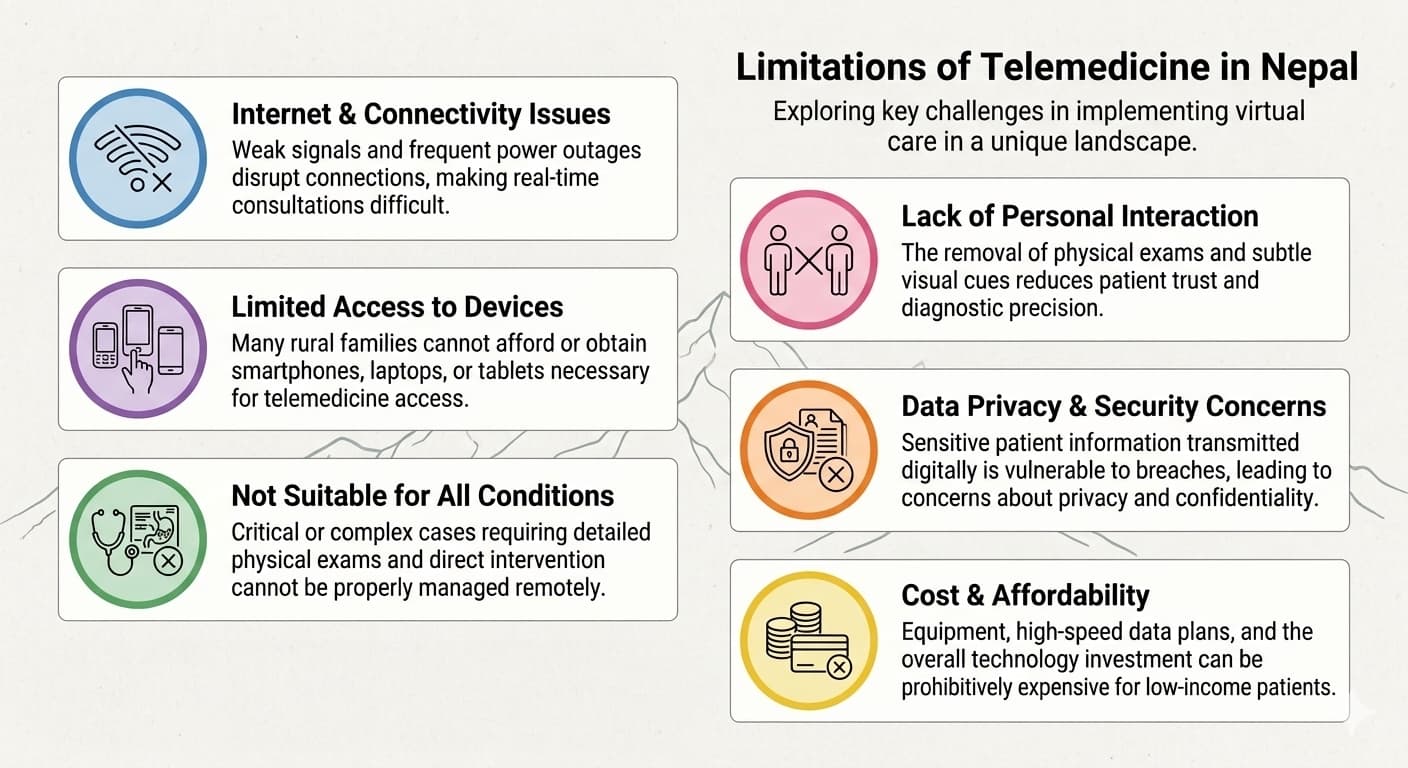
What Are the Limitations of Telemedicine?
Although telemedicine could offer many benefits, there could be limitations.
1. Sometimes a physical exam is required
There are some instances where the patient needs to come in for consultation
2. There are some tests that cannot be done online
Like blood tests, imaging, lab work, and many more that require a physical facility. The patient should not go for an online consult if their physician requires any of these types of tests;
3. There can be issues with internet access.
The patient would need internet access and a device to be able to communicate online via video
4. For emergencies, an ambulance ride should not be exchanged for an online video consultation.
The patient should get the emergency care they may need instead of waiting for an online appointment if they are experiencing potentially life-threatening symptoms.
5. There is protection of health information.
The patient could be exposing personal health information if they are not on a trusted network or website doing the online consultation. The healthcare company should have the legal protection of the patient's data and not put them on a non-trusted account or website.
How to Choose a Reliable Telemedicine Service?
There are several reasons why a patient should consider various aspects before using an online healthcare service.
Check the Doctor’s Credentials
A person should check the doctor’s qualifications and professional registration. An individual should look for the credentials of the medical professional.
The Nepal Medical Council (NMC) has a public registered-doctor search, where one can search with a doctor’s name or the NMC number. Checking credentials will help to ensure that the doctor is not on the NMC’s registered-doctor site. However, registration does not necessarily mean that the doctor will fulfill specific expectations regarding treatment outcomes.
Understand the Service
Prior to booking an appointment, one should check the type of service, consult by video, and what services are included.
Protect Personal Information
In the process, an individual should use a reliable site and should not give out personal information to a stranger.
Know the Limits of an Online Consultation
A patient should be aware that a doctor might ask him/her to come in for an examination or a test.
How to Prepare for a Telemedicine Consultation?
Patients can take several measures to ensure they have a highly productive online consultation.
Prepares a List of Questions
Before consulting online, the patient should prepare their questions in advance.
Bring Required Medical Records
Patients also need to bring all required medical records and papers along if they have any.
Develop a List of Current Medications
They may also have to provide a list of all their current drugs and ensure they are up-to-date in case they are asked during the consultation.
Ensures Quiet Place
A quiet and secure location where the patient can be alone without being overheard by others is appropriate for a video call.
Test Your Connection
A patient should test their connection ahead of time and ensure that their device’s camera, microphone, and power are not faulty.
The Role of Telemedicine in the Future of Healthcare in Nepal
Telemedicine will likely remain a significant topic of discussion in the sphere of digital healthcare in Nepal.
The Ministry is currently working on digital health initiatives that seek to improve access to information and services. The Ministry's Digital Health Platform concept comprises informational elements on healthcare facilities, appointment booking, and access to health records. Meanwhile, telemedicine must develop alongside traditional healthcare services.
Hospitals, clinics, laboratories, pharmacies, emergency services, and community health facilities will continue to be critical. Digital services can facilitate the connection of these elements rather than replacing them entirely.
The future of telemedicine will also depend on digital infrastructure, appropriate professional standards, patient confidentiality, and access to technology.
Conclusion
The role of telemedicine in the healthcare system of Nepal is closely related to the country’s geography, access to healthcare, and technology development.
Telemedicine enables the long-distance communication of patients’ vital signs to clinicians, helps with reaching follow-up treatments, facilitates consultations with medical experts, and promotes healthcare professional interactions through digital channels. Telemedicine is especially valuable in remote areas and for vulnerable populations; the government’s digital health strategy and telemedicine guidelines also note the importance of technological progress in healthcare.
The technology’s limitations should also be noted: telemedicine is unable to replace various essential medical procedures like physical exams, laboratory tests, emergency treatment, and other procedures requiring direct patient care.
Thus, patients should use telemedicine tools wisely and only when appropriate, choose providers carefully, ensure their data privacy and protection, and trust their doctors’ recommendations and instructions to receive the best possible treatment. With Nepal’s healthcare system continuously developing and becoming more technologically advanced, telemedicine can play an important role in connecting patients, medics, clinics, and hospitals across the country.
Frequently Asked Questions
What is telemedicine in Nepal?
Telemedicine is the use of information and communication technology to provide healthcare services remotely. Telemedicine facilitates consultation between patients and healthcare professionals.
How can telemedicine help healthcare in Nepal?
Telemedicine can help to overcome some geographical barriers to accessing healthcare in Nepal. Telemedicine can offer a range of services from consultations to examinations and other procedures.
Can telemedicine replace hospitals and clinics?
No, telemedicine cannot replace hospitals and clinics. Telemedicine provides an additional healthcare option while many procedures require physical examination, diagnostic tests, surgery, and other treatments that are available at hospitals and clinics.
Is telemedicine helpful for people living in rural areas of Nepal?
Telemedicine can be helpful for people living in rural areas of Nepal, when access to the necessary technology and internet is available. Telemedicine can help to reduce barriers to accessing healthcare.
Can I consult a specialist through telemedicine?
Consultations with a specialist can be possible with telemedicine services based on the availability of services and specialists. A specialist may also advise a patient that they need to see a health care provider in person.
How can I search for a doctor to verify if they are registered in Nepal?
Nepal Medical Council offers the Find Registered Doctor search tool where you can search for doctors by their name or NMC number.
Is telemedicine appropriate for emergency care?
Telemedicine should not be used as a substitute for emergency medical services. Individuals facing potentially life-threatening conditions should call emergency medical services.
