Every day millions of people with diabetes face the dilemma of choosing between a CGM vs finger prick. As Nepal experiences surging rates of diabetes, deciding which option is best for your health and budget only grows more important.
Both methods have value in the management of diabetes; however, understanding the differences may assist patients in better choosing the monitoring technology which helps them to manage their condition as well as their financial budget.
Blood Glucose Monitoring Methods
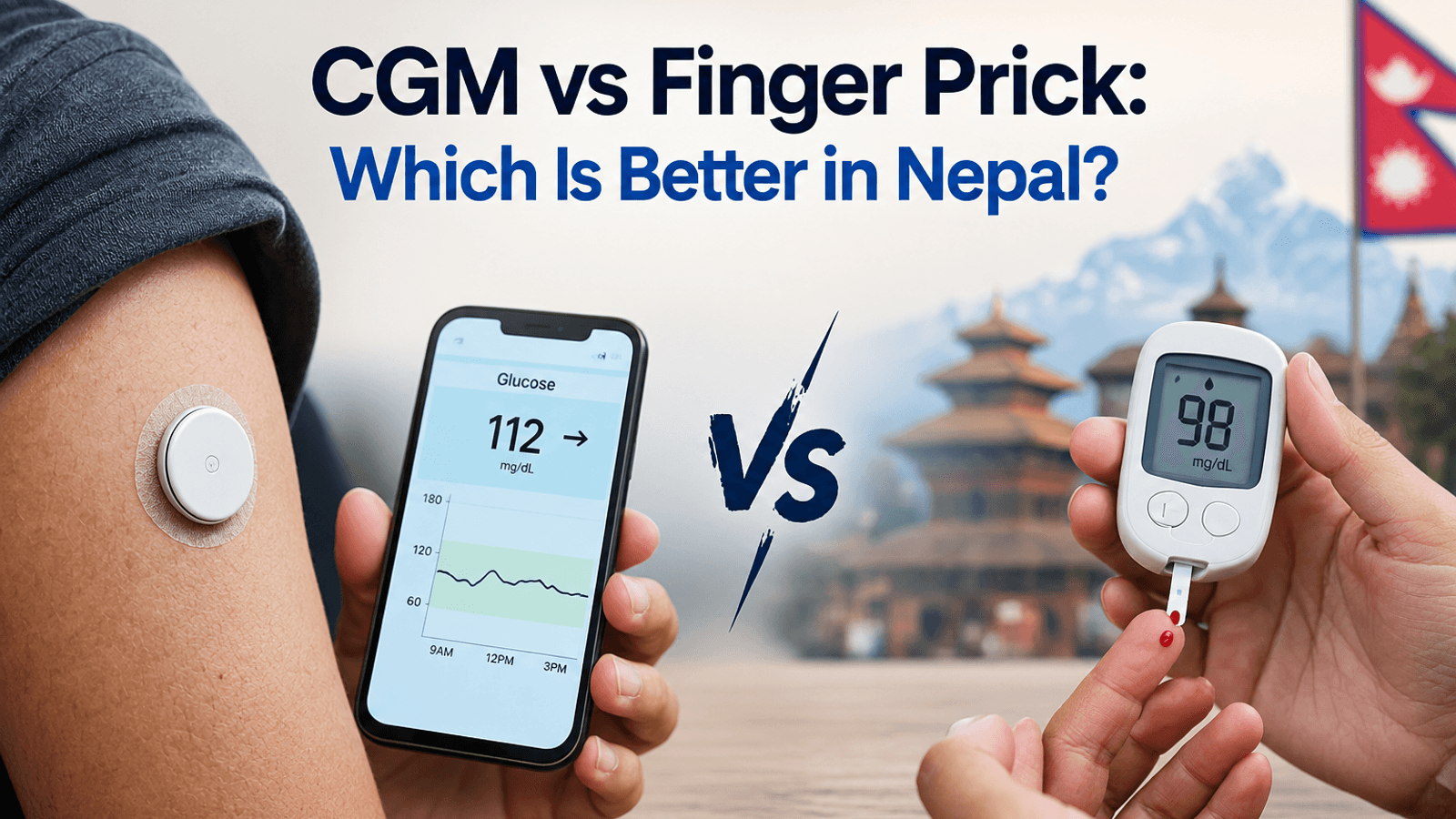
For the purpose of this article, we will refer to traditional finger-prick testing as using a blood glucose meter. With this method, a patient pricks his or her finger with a small needle and applies a tiny amount of blood to a test strip.
Next, the strip is inserted into a blood glucose meter which displays the current blood sugar level: all of this only takes a few seconds. In turn, a Continuous Glucose Monitoring system or CGM, uses a sensor to estimate blood glucose levels.
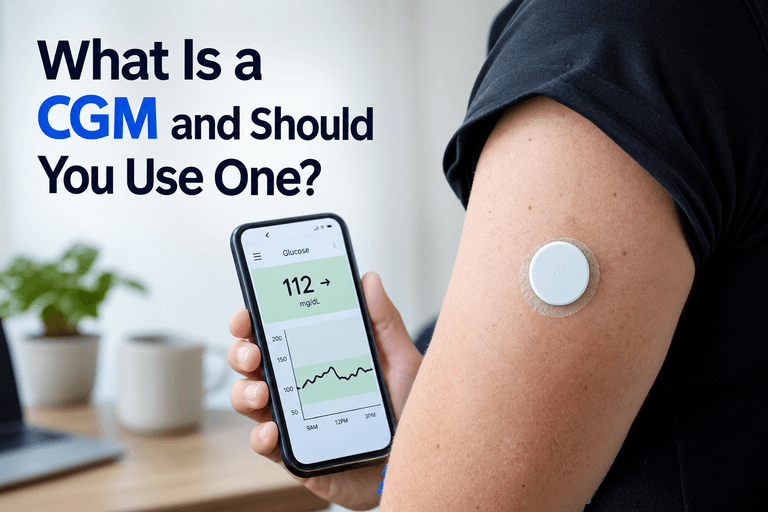
The sensor is placed just underneath the top layer of the skin and measures how much glucose is in the interstitial fluid (the fluid around the body’s cells). It lasts for ten to fifteen days and automatically uploads information to a smart phone or to a receiver every few minutes displaying blood sugar levels.
These two methods fundamentally differ: whereas a glucose meter directly measures blood sugar levels, CGM indirectly measures blood glucose by sensing how much sugar is in the fluid around the cells.
Accuracy of Reading
When it comes to the accuracy of the results, it is important to distinguish between one-time measurements and the overall estimation.
A glucose meter is more accurate than a CGM for a single measurement. A properly calibrated glucose meter will be ninety-five percent accurate fifteen percent of the time, according to the Food and Drug Administration (FDA).
Meanwhile, commercially available CGMs have a mean absolute relative difference (MARD) between nine to twelve percent and around eight percent for some of the latest models. Thus, they are also relatively accurate.
However, since a CGM indirectly measures blood sugar, it is typically five to fifteen minutes behind the real value. Therefore, in cases where a blood sugar level fluctuates rapidly, a finger-prick test is more accurate.
On the other hand, the accuracy of a glucose meter may be impacted by improper calibration and incorrect technique. Overall, for isolated measurements, a finger-prick test is more accurate; whereas, for an estimation of the overall tendency of blood sugar levels, a CGM is more reliable.
Cost-effectiveness in Nepal
Another critical difference between the two methods is the expenses related to them. A glucose meter is significantly more cost-effective than a CGM.
A proper meter can be purchased for as low as Rs. 800, whereas a single strip costs between Rs. 15 to Rs. 25. On average, a person with diabetes has to conduct four tests per day, which is equivalent to 1,460 tests per year.
Thus, the annual expenses for strips would be between Rs. 21,900 to Rs. 36,500. In addition, a glucose meter has to be replaced every two to three years, adding another Rs. 2,500 to the expenses.
In turn, a CGM may cost between Rs. 5,000 to Rs. 10,000 for the reader or the phone application, depending on the model. Sensors, which are used once and then disposed of after ten to fifteen days, account for the majority of the costs associated with CGM.
They can be purchased for between Rs. 9,000 to Rs. 27,000. Thus, for a person with diabetes, the annual expenses for a CGM would be between Rs. 18,000 to Rs. 54,000 or higher.
Therefore, compared to a glucose meter, a CGM is significantly more expensive. Even though some argue that a CGM can reduce overall health expenditures by being an effective tool for blood sugar control, for most Nepalese people, the value of such expenditures is questionable.
Convenience
A significant advantage of a CGM is the convenience of use: whereas a glucose meter and test strips require a constant supply, a CGM only has to be calibrated once every ten to fifteen days.
Moreover, whereas testing with a glucose meter is associated with the burden of testing multiple times per day and with pain associated with pricking fingers, a CGM is barely noticeable after it is placed beneath the skin.
With the use of a CGM, you do not have to worry about having test strips: you only have to change the sensor every two weeks. Additionally, readings only take a few seconds, and the ability to receive reports directly on your phone allows for greater discretion.
Instead of asking your boss to step outside the office to test your blood sugar, you only have to discreetly open the application on your phone. Furthermore, you can monitor your blood sugar levels at night without having to bother with the hassle of a glucose meter and test strips.
Information and Insights
Perhaps, the most substantial difference between a CGM and a glucose meter is the insight which the former provides into the general trends of blood sugar levels.
With a glucose meter, you are only able to obtain isolated readings which tell you very little about the overall tendencies and regular patterns of your blood sugar levels.
Meanwhile, with a CGM, you can track your sugar levels with much greater precision and be aware of potential spikes and drops in your blood sugar levels.
For example, when using a glucose meter, you may be able to check your blood sugar levels before breakfast, lunch, dinner, and before going to bed: that is, only four times per day.
With a CGM, you can see how your blood sugar levels change throughout the day, after eating different meals, and after engaging in physical activity. You can also check if your blood sugar tends to drop below normal too quickly during the night.
Additionally, with a CGM, you can also assess how quickly your blood sugar rises and falls after eating: thus, being able to estimate how healthy your meals are.
The arrows associated with most CGMs are particularly useful: they indicate whether your blood sugar is rapidly rising or falling or whether it is stable and within the normal range.
That information alone can allow you to make better dietary and lifestyle choices.
Finally, a CGM typically offers greater opportunities for communicating with a healthcare professional and compiling reports which may be necessary for reviewing your treatment plan.
In summary, whereas a glucose meter only provides isolated measurements of blood sugar levels, a CGM provides more insight into the overall tendencies and general trends.
Applicability
A glucose meter is applicable to almost everyone with diabetes.
Most people with Type 2 Diabetes do not have to check their sugar levels more than once per week: thus, a CGM would be an unnecessary expenditure for them.
For those considering the financial burden associated with a CGM, a glucose meter is significantly more cost-effective.
Finally, there are also some people who prefer a glucose meter due to the technological literacy required for a CGM.
The use of a CGM is also particularly advantageous in certain circumstances. For example, a CGM may be especially beneficial for children and adolescents with Type 1 Diabetes who require regular and frequent testing.
People who often experience nocturnal hypoglycemia (low blood sugar at night) can greatly benefit from the use of a CGM.
Pregnant women with gestational diabetes also greatly benefit from a CGM: it allows for the most physiologically appropriate control of blood sugar levels without causing discomfort.
Finally, athletes who are highly physically active and whose blood sugar levels often fluctuate greatly can also benefit from the insights provided by a CGM.
People who often experience hypoglycemia unawareness (the inability to recognize low blood sugar levels) are strongly recommended to use a CGM.
Some people use a hybrid approach: they use a CGM most of the time, but use a glucose meter to confirm the accuracy of results when it is necessary.
Such an approach combines the advantages of both methodologies: the ability to constantly track blood sugar levels with minimal inconveniences and the opportunity to obtain a more accurate measurement when needed.
Reality Check: Living in Nepal
Some differences which were discussed above, only exist on paper: in reality, living in Nepal introduces additional considerations.
For example, a CGM requires users to buy additional sensors which can sometimes be unavailable. Although it is possible to buy them on the websites of Daraz, Medcare Surgical, and similar resources, there is always a possibility of a sensor being unavailable when you need it.
You will still need a backup glucose meter anyway: there is little point in having a CGM if you cannot track your blood sugar levels due to a faulty sensor.
There are also fewer options when it comes to technical support in Nepal: if your CGM stops working, your application malfunctions, or you cannot sync your data to your phone, then there is not much you can do besides perhaps return the product.
A glucose meter is much more reliable and technically simple: it does not require any special expertise and can be used anywhere and at any time.
Electricity and internet connectivity is still an issue in Nepal, making a CGM a less convenient method of blood sugar tracking.
Finally, most physicians do not fully understand the reports which a CGM provides and are unable to adequately interpret them. Although consulting with specialists online has become much easier because of Upachar Sewa, there are still fewer doctors in Nepal who have sufficient understanding of diabetes to be able to interpret the data provided by a CGM.
Making the Final Decision
First, assess your general situation and determine what is best for your diabetes.
If your diabetes is generally well controlled and you only have to check your sugar levels occasionally, a glucose meter is likely to be more beneficial and cost-effective.
On the other hand, if you regularly have difficulties managing your condition and you often have diabetic emergencies, a CGM may provide the much-needed additional insight.
Next, calculate your real-life risks and weigh the costs associated with a CGM against your individual circumstances.
If frequent finger-prick tests irritate you or prevent you from leading a normal lifestyle, then a CGM may be worth the additional investment.
However, if you are generally able to maintain a consistent schedule and do not have to skip many activities because of diabetes, a glucose meter can be more beneficial.
Finally, be completely honest with yourself when it comes to finances: can you afford additional monthly expenses associated with a CGM?
If you can, and there are no other reasons for you to refrain from purchasing a CGM, then it may be a great idea.
However, if you cannot, there is nothing wrong with a glucose meter.
Talk to Your Doctor
Ultimately, the final decision should be made in consultation with a physician.
Only he or she can analyze your unique circumstances and provide you with professional advice.
You can consult NMC-verified diabetes specialists on Upachar Sewa to discuss the situation without having to spend much time and effort on getting there.
In Summary
Both technologies have significant advantages and disadvantages.
A glucose meter is more cost-effective and is relatively straightforward to use.
A CGM provides greater insight into your blood sugar levels, is less intrusive, offers additional warning signals, and is generally more convenient.
Ultimately, the choice between a CGM and a glucose meter is personal and should be based on individual circumstances and priorities.
For some people in Nepal, a glucose meter is more appropriate: a daily finger-prick is not as inconvenient as it may seem.
For others, the additional insight and convenience of a CGM are much more beneficial. Some people are even capable of using both technologies in combination with one another.
The key point is that the method of blood sugar monitoring is only a small part of the equation.
No matter which method you choose, it is essential to continue to work with your healthcare provider, follow lifestyle and dietary recommendations, and adhere to the prescribed treatment regimen.
Your health and wellbeing are important, and so is your ability to manage diabetes in the best possible way.
If you are unsure what to do, consult a diabetes specialist on Upachar Sewa. They will help you analyze your unique situation and choose a method which fits your needs and priorities.